Showing posts with label 1910 deaths. Show all posts

Tuesday, September 20, 2022

Rackley Deane Leavitt (1842-1910)

From the Maine Legislature composite photo, 1903.

  Prominent in the workings of the Maine State Grange, Rackley Deane Leavitt was for eight years a member of the Maine Grange executive committee and was a founder of the Norland Grange of East Livermore. Additionally, Leavitt was politically active in his native town of Turner, serving as its first selectman, and in 1902 was a successful candidate for the Maine House of Representatives. The son of Arch and Polly (Deane) Leavitt, Rackley Deane Leavitt was born in Turner on November 7, 1842. In preparation for this article, some confusion arose as to Leavitt's first name, which is given by nearly every source as "Rackley". However, his obituaries from two area newspapers in 1910 denote it as "Rackliffe." After searching through census records dating back to the 1860s, finding his marriage certificate (where the spelling is Rackley), his death certificate, and Leavitt's own gravestone (again, Rackley), I am comfortable in assuming Rackliffe was a mistake on the part of the newspaper editors, as all other period sources give Rackley as his first name. All in all, very confusing!
  A student in schools local to Turner, Leavitt later graduated from Edward Little High School in Auburn. He followed a teaching career during his youth and married in 1867 to Ada Bicknell (1844-1921), to who he was wed until his death. The couple had three children, Arch Deane (born 1869), Warren Rackley (born 1871), and Julia Agnes (born 1877).
  In the years following their marriage, the Leavitts resided in Turner on a 400-acre farm, one of the largest in Androscoggin County. Their farm was noted for its "highly productive land" and provided food and income for the family until its destruction by fire in the early 1900s. 
 Beginning in the late 1890s, Leavitt was named chair of the board of trustees of the Leavitt Institute in Turner, a school endowed and established by his wealthy cousin, James Madison Leavitt, and proved to be "very influential in its management." Other business pursuits included a directorship in the North Turner Cheese Co. in the mid-1870s, as well as being a founder and director of the Patrons Androscoggin Mutual Fire Insurance Co.
  Long active in the Granger movement in his state, Leavitt was a founder of the Noland Grange of East Livermore, an early member of the Turner Grange, and a past master of the Androscoggin Pomona Grange. In the position of state deputy in the Maine State Grange, he was a sought-after public speaker on agricultural topics and later served several years on the executive committee of the Maine Grange, including a term as chairman in 1902-03.

From the Lewiston Daily Sun, August 5, 1902.

  Rackley Leavitt began his political career as first selectman for Turner, and in 1899 was the town agent for the settlement of Howe's Corner, located in Turner. In 1902 he was a delegate from Turner to the Androscoggin County Republican Convention, and in that year was nominated for a seat in the Maine House of Representatives. He won the election and from 1903-05 held seats on the committees on Agriculture and Salaries. Although he served just one term, Leavitt's service was favorably remembered by the Lewiston Sun-Journal, which noted that he:
"Served with conspicuous ability. His unerring judgement was often sought by legislators who were more in the public eye than himself."

  Following his term, Leavitt remained a force in the state grange and with his insurance company. After the fire that destroyed his family's home, he moved to Auburn, where he would be named a city assessor in the early 1900s. He was struck by a lengthy illness during his last years, and on July 1, 1910, was admitted to a Boston, Massachusetts hospital. He underwent an operation shortly after, and although he survived, his health continued to fail. Rackley Dean Leavitt died in Boston on August 7, 1910, aged 68.  He was survived by his wife and children and was returned to Turner for burial at the East Burial Grounds. Months following his death Leavitt was memorialized in the proceedings of the state grange as an "esteemed and honored brother", and as:

" A man of broad ideas, with a concientious regard for call of duty; of fearless courage in standing for and advocating what he believed to be right; a man of kindly heart, whose sympathy was deeply stirred by any real call of distress and whose many good deeds, unrecorded, were known only to himself and the angels above, and we will ever cherish in memory the noble influence upon us and the world."
From the Lewiston Daily Sun, August 9, 1910.

Sunday, February 14, 2021

Syfax Milton (?--1910)

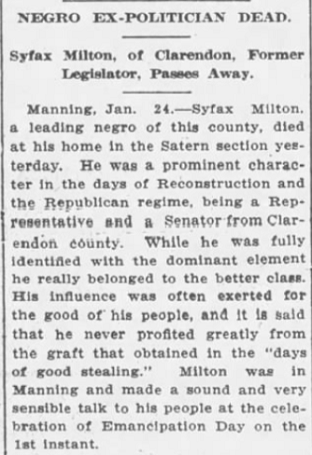
From the Watchman and Southron, January 29, 1910.

  A Reconstruction-era black legislator from South Carolina, Syfax Milton served three terms in the South Carolina House of Representatives. One of a number of freedmen elected to legislative seats in the South in the years following the Civil War, Milton's life and career are shrouded in obscurity, and aside from the obituary shown above, little else is known of him. A portrait of Milton has also proven elusive, as has his date of birth. Additionally, his first name has a variation in spelling, being given as Syphax.
 In 1870 Milton was elected as one of two state representatives from Clarendon County; his fellow legislator, Jared Warley, also being African-American. During the 1870-72 session, Milton sat on the committee on the State House and Grounds and continued political service in 1874 when he represented Clarendon at the Union Republican State Convention. Milton would also serve a term as Clarendon County Commissioner in 1874, but no source details the length of that term.
  Syfax Milton won a second term in the house in late 1874, and during the 1874-76 session was named to the committees on Mines, Mining and Manufactures, and Public Lands. In 1876 he was elected to a third term and was named to one new committee, Contingent Account and Expenses. This term saw Milton propose one piece of legislation, "a bill to allow the County Commissioners of Clarendon and Sumter County to open a certain road in said Counties."
  Two years after leaving the legislature Syfax Milton again represented Clarendon County at the Union Republican State Convention, and was again a delegate in 1882. In the late 1880s he is recorded as chairman of the Clarendon County Republican party, and at the county Republican convention of 1890 was made permanent president. He continued to be a influential figure in county politics through the remainder of that decade, and stepped down as county chairman in 1895 due to impaired health.

From the Manning Times, November 25, 1891.

  Little is known of the remainder of Milton's life, and just weeks before his death, the "old war horse" of the county Republican party gave an Emancipation Day address to a large crowd in Manning, South Carolina. This address was remarked by the Manning Times as "teeming with sound advice, and teaching a lesson of industry, thrift, and integrity ", and was followed by oratory from the Rev. James Adams. On January 23, 1910, Syfax Milton died at his home in the "Salem" area of Manning, with notices of his death being published in several South Carolina newspapers. While described as "one of the better class of politicians" by the Manning Times, this same paper gave a Milton a backhanded memorialization following his death, noting:
"The younger generation that has come upon the stage cannot realize the conditions that existed in this State during reconstruction and the republican regime. In those days Syfax Milton was a power in the land. Though not an educated man he was possessed of a goodly share of sound, common sense. He was indentified with the ring streaked and striped element that controlled in those days being a representative and senator from Clarendon County, but his influence was not always for the bad nor did he profit greatly by the graft that was obtained in those days of good stealing."

You Can Help!! 

 A burial location for Syfax Milton remains unknown at this time, as does information concerning his possibly being born into slavery, his parentage, or whether or not he married and had children. If you are a reader, historian or possible descendant and have information you'd like to contribute, please send along a message below, or via this site's Facebook page!

From the Manning Times, January 26, 1910.

Wednesday, October 28, 2020

Jaynes Bailey Wheeler (1853-1910)

From the Men of Progress, Wisconsin, 1897.

  The Strangest Names In American Political History makes its first stop in Wisconsin for 2020 to highlight the life of Jaynes Bailey Wheeler. So far the only "Jaynes" discovered by this author, Wheeler was a transplant to Wisconsin from Vermont, and after being admitted to practice law established himself in Walworth County. He would win a term as District Attorney for Walworth County in the early 1880s and later served thirteen years as county judge. The son of Lyman Blandin (1825-1870) and Sally (Johnson) Wheeler (1826-1878), Jaynes Bailey Wheeler was born in Pawlet, Vermont on February 28, 1853.
  A student in schools local to Pawlet, Wheeler pursued a career in law at an early age, enrolling at the Albany Law School in late 1873. He graduated in 1875 and shortly thereafter relocated to Elkhorn, Wisconsin, where he was admitted to the state bar. In 1877 he formed a law practice with H.E. Smith, which extended nearly a decade, and on April 24, 1879, married Ella Shaw (1857-1899). The couple were wed until Ella's death and had two childrenMargaret (1880-1948) and James Blaine (1883-1933).
   Active in several fraternal organizations in Walworth County, Wheeler was a member of the Ancient Order of United Workmen, the International Order of Oddfellows, the Knights of Pythias, and the Knights Templar Masons. In 1879 he entered politics with his successful run for district attorney of Walworth County, serving from 1880-1882. In 1885 he was elected as county judge on the non-partisan ticket, succeeding Peter Golder, who had served nearly thirty years in office. Wheeler took his seat on the bench in January 1886 and won a second term in 1889. In 1893 the voters returned him for a third term, and in 1897 won a fourth term, this win being "a most conclusive evidence of Judge Wheeler's efficiency in office, and of his personal popularity."
  Jaynes Wheeler resigned the judgeship in January 1899, and by February had removed back to Vermont. Settling in Rutland, Wheeler assumed the post of associate director of his family's fertilizer business, the M.E. Wheeler and Co. Headed by his brother Marcellus Edgar (1850-1927), the company was remarked as one of the largest fertilizer dealers in the United States, with "over five thousand agents" scattered throughout the country. 
  Several months following his return to Vermont Wheeler suffered the loss of his wife of twenty years, Ella. Two years after her death he remarried to Elizabeth J. Murray (1872-1958), with who he had one son, Murray Jaynes Bailey Wheeler (1902-1984). The couple was wed until Wheeler's death from pneumonia on April 14, 1910, aged 57. Following his death, he was entombed in the Wheeler family mausoleum at the Evergreen Cemetery in Rutland, Vermont.

From the Bennington Evening Banner, April 16, 1910.

Friday, July 22, 2011

Cherubusco Newton (1848-1910)

Portrait from Herringshaw's Encyclopedia of American Biography of the 19th Century.

   A prominent lawyer and legislator in 19th century Louisiana, Cherubusco Newton's first name is truly one-of-a-kind. Research on Mr. Newton's life was somewhat hampered by the rather inconsistent spelling of his first name, which is variously given as "Cherubusco", "Churubusco" and "Curubusco". Seeing that Newton was born on May 15, 1848, one year following the famous Battle of Churubusco during the Mexican-American War, it is in all likelihood that he was named after that particular battle. I first discovered Mr. Newton's name in 2001 while perusing the website www.politicalgraveyard.com and other than the information obtained there, little else could be found on him other than his short tenure in Congress. This remained the norm until websites (such as Wikipedia and Infoplease) began offering up small, brief blurbs on the man whose profile you are now reading.
   Cherubusco Newton was born in St. Helena Parish, Louisiana, the son of Daniel and Nancy Wright Newton. He attended the State Seminary of Learning in Alexandria and graduated from Louisiana State University. He began teaching school soon afterward and in 1870 passed the Louisiana state bar exam. Over the next few years Newton gained statewide distinction as an attorney, and the Biographical and Historical Memoires of Louisiana (Volume II) mentioned that his firm "was ranked second to none in the northern part of the state." Newton married in 1879 to Amanda Cason (the sister of his law partner J.T. Cason) with whom he would have two sons, Thomas C. Newton (born 1886) and Sterling M. Newton, both of whom went on to distinguished careers as lawyers.
   In 1879 Newton was elected to the Louisiana State Senate and this four-year term saw him sit on the judiciary committee and chair the Committee on Public Education. In 1886 he was nominated by the Democrats for a seat in the U.S. House of Representatives and that November trounced his Republican opponent, G.L. Walton, by a vote of 13,618 to 495. He took his seat in March 1887 and was a member of the committees on the Eleventh Census, and Public Buildings and Grounds. He served one term, being defeated for renomination by Charles Jahleal Boatner (1849-1903) in November 1888. 

A recently located portrait of Newton, found May 19, 2020, via the Library of Congress.

  In 1888 Newton was named as a delegate to that year's Democratic National Convention in St. Louis that renominated Grover Cleveland for President. At the expiration of his congressional term in 1889, Newton returned to Louisiana and continued with his earlier law practice. The Biographical and Historical Memoires of Louisiana Volume II notes that Newton was also a "successful financier and has accumulated a comfortable competency and a considerable fortune."
  In 1893 Newton and his family moved to Monroe, Louisiana. Cherubusco Newton died at his home there shortly after his 62nd birthday on May 26, 1910, and was survived by his wife and sons. Following funeral arrangements, his body was later interred at the New Cemetery in Bastrop, Louisiana

                                                          From the 1886 Troy Daily Times.