Showing posts with label Maine House of Representatives. Show all posts

Tuesday, September 27, 2022

Shapleigh Chandler Drisko (1877-1938)

From the Maine legislature composite portrait of 1931.

   A three-term Maine state representative who was first elected in 1930, Shapleigh Chandler Drisko was a farmer and lumberman in Washington County who held a variety of local offices during his life, including school board member, selectman, and tax assessor. The son of Joseph Whitney Drisko and the former Isabel Frances Farnsworth, Shapleigh Drisko was born in Jonesboro, Maine on February 15, 1877. Little information could be found on Drisko's early life or education, and in May 1903 married Myra Luella Noyes (1876-1952), to who he was wed until his death. The couple would be childless.
   While there is a dearth of resources mentioning Drisko, his 1938 obituary gives note as to his employment with the Eastern Pulpwood Co. of Calais, Maine as a purchasing agent. He is also mentioned as a farmer. In 1903 he was elected as Jonesboro town tax assessor and five years later was serving as first selectman, an office he'd be returned to on several further occasions. In 1911 he was serving Jonesboro as one of two town constables and in 1916 made his first run for the Maine legislature but was defeated.
  In 1930 Drisko was again a candidate for the legislature and was this time elected. During the 1931-33 term he was a member of the committee on Federal Relations, and after winning a second term in 1932 was named to the additional committee on Cities and Towns. Drisko's final term (1935-37) saw him serve on the committee on Education.
  Little else is known of Drisko's life, except notice of his death in Machias, Maine on March 19, 1938. His wife Myra survived him by fourteen years, and after her death in 1952 was interred alongside him at the Forest Hill Cemetery in Jonesboro.
  
From the Bangor Daily News, March 21, 1938.

Tuesday, September 20, 2022

Rackley Deane Leavitt (1842-1910)

From the Maine Legislature composite photo, 1903.

  Prominent in the workings of the Maine State Grange, Rackley Deane Leavitt was for eight years a member of the Maine Grange executive committee and was a founder of the Norland Grange of East Livermore. Additionally, Leavitt was politically active in his native town of Turner, serving as its first selectman, and in 1902 was a successful candidate for the Maine House of Representatives. The son of Arch and Polly (Deane) Leavitt, Rackley Deane Leavitt was born in Turner on November 7, 1842. In preparation for this article, some confusion arose as to Leavitt's first name, which is given by nearly every source as "Rackley". However, his obituaries from two area newspapers in 1910 denote it as "Rackliffe." After searching through census records dating back to the 1860s, finding his marriage certificate (where the spelling is Rackley), his death certificate, and Leavitt's own gravestone (again, Rackley), I am comfortable in assuming Rackliffe was a mistake on the part of the newspaper editors, as all other period sources give Rackley as his first name. All in all, very confusing!
  A student in schools local to Turner, Leavitt later graduated from Edward Little High School in Auburn. He followed a teaching career during his youth and married in 1867 to Ada Bicknell (1844-1921), to who he was wed until his death. The couple had three children, Arch Deane (born 1869), Warren Rackley (born 1871), and Julia Agnes (born 1877).
  In the years following their marriage, the Leavitts resided in Turner on a 400-acre farm, one of the largest in Androscoggin County. Their farm was noted for its "highly productive land" and provided food and income for the family until its destruction by fire in the early 1900s. 
 Beginning in the late 1890s, Leavitt was named chair of the board of trustees of the Leavitt Institute in Turner, a school endowed and established by his wealthy cousin, James Madison Leavitt, and proved to be "very influential in its management." Other business pursuits included a directorship in the North Turner Cheese Co. in the mid-1870s, as well as being a founder and director of the Patrons Androscoggin Mutual Fire Insurance Co.
  Long active in the Granger movement in his state, Leavitt was a founder of the Noland Grange of East Livermore, an early member of the Turner Grange, and a past master of the Androscoggin Pomona Grange. In the position of state deputy in the Maine State Grange, he was a sought-after public speaker on agricultural topics and later served several years on the executive committee of the Maine Grange, including a term as chairman in 1902-03.

From the Lewiston Daily Sun, August 5, 1902.

  Rackley Leavitt began his political career as first selectman for Turner, and in 1899 was the town agent for the settlement of Howe's Corner, located in Turner. In 1902 he was a delegate from Turner to the Androscoggin County Republican Convention, and in that year was nominated for a seat in the Maine House of Representatives. He won the election and from 1903-05 held seats on the committees on Agriculture and Salaries. Although he served just one term, Leavitt's service was favorably remembered by the Lewiston Sun-Journal, which noted that he:
"Served with conspicuous ability. His unerring judgement was often sought by legislators who were more in the public eye than himself."

  Following his term, Leavitt remained a force in the state grange and with his insurance company. After the fire that destroyed his family's home, he moved to Auburn, where he would be named a city assessor in the early 1900s. He was struck by a lengthy illness during his last years, and on July 1, 1910, was admitted to a Boston, Massachusetts hospital. He underwent an operation shortly after, and although he survived, his health continued to fail. Rackley Dean Leavitt died in Boston on August 7, 1910, aged 68.  He was survived by his wife and children and was returned to Turner for burial at the East Burial Grounds. Months following his death Leavitt was memorialized in the proceedings of the state grange as an "esteemed and honored brother", and as:

" A man of broad ideas, with a concientious regard for call of duty; of fearless courage in standing for and advocating what he believed to be right; a man of kindly heart, whose sympathy was deeply stirred by any real call of distress and whose many good deeds, unrecorded, were known only to himself and the angels above, and we will ever cherish in memory the noble influence upon us and the world."
From the Lewiston Daily Sun, August 9, 1910.

Sunday, September 18, 2022

Albanah Harvey Libby (1868-1936)

From the Maine legislative composite photo of 1929.

  We continue our journey through Maine and today examine the life of Albanah Harvey Libby, a one-term state representative from Albion in Kennebec County. The son of former state legislator Llewellyn (1841-1928) and Angie (Drake) Libby, Albanah H. Libby was born in Albion on April 29, 1868. He inherited his unusual name in honor of his paternal uncle, Pvt. Albanah Harvey Libby (1843-1864), who died in a Confederate prison in Salisbury, North Carolina in October 1864. 
   Libby's early life and education passed in his hometown of Albion, and in April 1889 he married Margaret Jeannette "Janette" Stevens (1868-1931), to who he was wed until her death. The couple had one daughter, Dorothea (1896-1947). Following his marriage, Libby moved to Waterville, Maine, and in the early 1900s was a partner in the firm of Clukey and Libby Co., a department store that distributed "wholesale dry goods, boots and shoes, millinery." Libby served as the company's president, with Charles F. Clukey as treasurer. 
  Around 1906 Libby left his firm and joined C.E.B. Walker in the latter's clothing company, operating under the name Walker Clothing Co. After nearly two decades of residence in Waterville Albanah Libby resigned from that business and by 1912 had returned to his old home of Albion, where he became "a prosperous merchant", partnering with his brother in the Libby Bros. firm. In 1928 he announced his candidacy for the Maine House of Representatives and that June won the Republican primary, besting Charles Bessey, 457 votes to 208.

From the Waterville Morning Sentinel, June 19, 1928.

  In September 1928 Albanah Libby won his house seat and at the start of the 1929-31 session was named to the committees on Engrossed Bills and Public Health. Shortly after the conclusion of his term Libby lost his wife of nearly forty years, Janette, who died following a short illness. His final years were spent in Albion, where he was a member of the local Masonic and Odd Fellows chapters, and died in that town on May 16, 1936, aged 67. He was interred alongside his wife at Albion Cemetery #4.

From the Kennebec Journal, May 18, 1936.

Thursday, September 15, 2022

Stetson Harlow Hussey (1887-1976)

From the 1921 Maine legislative composite photo.

  A practicing lawyer for nearly sixty years, Mars Hill resident Stetson Harlow Hussey served terms in both houses of the Maine legislature and in addition to his law practice was a lobbyist for the International Paper Company. The son of Harrison Otis and Lucy Lowell Hussey, Stetson Harlow Hussey was born in Mars Hill on June 10, 1887. A student at the Ricker Classical Institute in Houlton, Maine, Hussey decided upon a career in law at an early age, enrolling at Bowdoin College in Brunswick. He later graduated from Yale Law School and began his practice in Mars Hill in 1914. He married ca. 1915 to Gladys Wyona Goodhue (1889-1977), to who he was wed for over sixty years. The couple had two children, Mary H. Hussey McBride (1916-2016, aged 100) and Stetson Harlow Hussey Jr. (1918-2005).
  In addition to his law practice, Stetson Hussey served as a notary public and in the summer of 1918 announced his candidacy for the Maine House of Representatives. Remarked by the Mars Hill News as young and "ably qualified", Hussey hit the stump throughout that summer and would win the Republican primary in June. He went on to win the general election that November and took his seat in January 1919. Named to the committee on Education, Hussey made a visit home to Mars Hill in March 1919 and noted that not only was he enjoying his legislative experience but that "business at the capitol was being transacted expeditiously."

From the Mars Hill News, June 13, 1918.

  Announcing his bid for reelection in 1920, Hussey won a second term that November and during the 1921-23 session was a member of the committees to Inform the Governor of His Election and Legal Affairs. Early in his second term Hussey was named a candidate for Maine's assistant attorney general. His tentative appointment, given by Attorney General Ransford W. Shaw, was reported on by the Mars Hill News in May 1921, which noted:
"Mr. Hussey is one of Aroostook County's prominent young attorneys and was a member of the house of representatives from his class in Mars Hill and in the appointment the attorney general has used excellent judgement as Mr. Hussey is not only well posted in his profession but is a student and man with a pleasing personality as well as having the ability to do the work of the office in a most satisfactory manner."

 Ultimately, Hussey turned down the appointment to continue serving in the legislature, and in 1922 set his sights on a state senate seat. With two successful house terms behind him, Hussey's candidacy was boomed by the Mars Hill News in June 1922, which remarked:

"Of all the candidates for State Senator at the June primaries we know of no more logical candidate than Stetson H. Hussey of Mars Hill. We do not say this wholly because he is a local man but because of his business training and experience along these lines makes him well fitted for the position."
From the Kennebec Journal, January 5, 1921.

  Following his senatorial win in late 1922, Hussey served on the committees on Engrossed Bills and Sanitariums in the 1923-24 session and was reelected to a second term in 1924. During this term, Hussey returned to Aroostook County to take part in the county republican convention, and in April was named as its committeeman on resolutions.
  At the conclusion of his second term in 1927, Hussey returned to his law practice in Mars Hill and later served a term as president of the Aroostook County Bar Association. He would be joined in practice by his son Stetson in 1948 and retired from his law office in 1973. For a time Hussey had been a lobbyist with the International Paper Company, but no source notes as to his dates of service. Additionally, Hussey was a past master of the Aroostook Masonic chapter, a charter member of the Mars Hill Rotary Club, and a founder and honorary director of the Aroostook Health Center.
  Stetson Harlow Hussey died on September 4, 1976, aged 89, at a nursing facility in Presque Isle, Maine. His wife Gladys survived him by less than a year, and following her death in 1977 was interred alongside him at the Kings Grove Cemetery in Mars Hill.

From the Bangor Daily News, Sept. 6, 1976.

From the Waterville Morning Sentinel, September 6, 1976.

Tuesday, September 13, 2022

Belonie Simon Dufour (1864-1933)

From the Maine legislative composite of 1909-10.

  A prominent citizen residing in St. Agatha, Maine, Belonie Simon Dufour held multiple political offices in that town, was a school superintendent, furniture store owner, bank cashier, and a leading club-man in his region. Dufour earns a spot here on the site with his service in the Maine House of Representatives, where he served two terms. Born of New Brunswick parentage in Madawaska, Aroostook County, Maine Belonie S. Dufour was the son of Eusebe (1812-1898) and Modeste (Soucy) Dufour (1822-1890).
   Dufour's early education was obtained at the Madawaska Training School under Joseph Vital Cyr in Fort Kent. Dufour married in St. Basile, New Brunswick in October 1893 to Annie Beaulieu (1878-1918), and the couple's twenty-five-year union produced four children, Alfred (died 1898) Wilfred (1894-1980), Annie (1895-1979), and Pierre Paul (1908-1971). Shortly after his marriage, Dufour settled in St. Agatha, where he took employment as a clerk in the general store of Israel Ouellette. 
  In 1899 St. Agatha was separated from the town of Frenchville and incorporated, and soon after Belonie Dufour was elected as the town's first selectman and town clerk. This position was followed by a stint as registrar of wills, justice of the peace, and notary public. He achieved further local distinction as town superintendent of schools and held the additional role of school board member. In 1908 he was elected as a representative from Aroostook County to the Maine house of representatives, and in the 1909-11 term sat on the State Lands and State Roads committee. He won a second term in late 1910 and during the 1911-12 session served on the committee on the State School For Boys and the Industrial School For Girls.
  A leading figure in the fraternal life of his region, Dufour was a longstanding member of the Modern Woodmen of America, serving as recorder for its local chapter for 25 years. He also held memberships in the Catholic Order of Foresters, the Knights of Columbus Council 1102 of St. Agatha, and the Royal Neighbor Council. 
  Throughout his life, Belonie Dufour was invested in several business concerns in the Aroostook County area, including being a founder of the Long Lake Starch Company. He was its manager for twelve years and later served two years as a cashier for a branch of the Van Buren Trust Co. in Frenchville. Sources also note his owning a furniture store and dealing in farm implements. Widowed in 1918, he later remarried Marie Legasse, who survived him. After many years of prominence in his region, Belonie Dufour died on April 15, 1933, aged 67. He was interred alongside his wife Annie at the St. Agatha Lower Cemetery.
  
Dufour as he looked during his time in the legislature.

Sunday, September 11, 2022

Plympton Cyrus Kent (1905-1972)

From the Kennebec Journal, June 15, 1946.

  Following the article on Kennebec County's Ernfrid Jacob Crosby, another oddly named representative from that county is profiled, Plympton Cyrus Kent. Equally as obscure as the man who preceded him, Kent owned a "retail meat and grocery store" at the time of his election to the Maine state legislature in 1946. Born in Benton, Maine on June 26, 1905, Plympton C. Kent was the son of Charles and Bertha (Roundy) Kent. 
  Little information could be found on Kent's early life or education, and on December 25, 1926, he married Angelina Perry, with who he had two children, Plympton Jr and Shirley. The owner and operator of Kent's Market in Gardiner, Maine for nearly thirty years, his business added a meat market in 1935, necessitating a move to a larger building.  A resident of Randolph, Maine beginning in 1930, he was a parishioner at the United Methodist Church of Benton and held memberships in the Hermon Lodge of Free and Accepted Masons, the Kora Temple Shriners of Lewiston, and the International Order of Oddfellows. 
  After years of prominence in the Kennebec County business community, Plympton Kent entered politics in April 1946 when he announced his candidacy for the Maine House of Representatives. Hoping to represent his hometown of Randolph, Kent won the election that November and during the 1947-49 term was a member of the Salaries and Fees committee. Reelected in November 1948, Kent served on one new committee, State Hospitals. After his reelection, Kent was profiled in the Waterville Morning Sentinel, where he is mentioned as an incorporator of the Gardiner Savings Institution, a board member of the Gardiner Board of Trade, and a member of the Gardiner Driving Club, This paper further notes his dealing in livestock in connection with his meat market.

From the Kennebec Journal, June 13, 1946.

  Following the 1949-50 session Plympton Kent announced his candidacy for the state senate on the Republican ticket, running on the slogan "A Businessman for a Business Job". One of three candidates running in that year's primary, Kent lost out that June to Gardiner farmer Foster Tabb, who polled 1,000 more votes. 
  Several months after his defeat Kent was reelected as president of the Gardiner Driving Club, a harness racing group. He was reelected to a fourth term as president in December 1952 and later retired from his meat market business. Plympton Kent died unexpectedly at his home in Randolph on June 13, 1972, shortly before his 67th birthday. He was survived by his wife and children and was interred at the Richmond Cemetery.

Thursday, September 8, 2022

Ernfrid Jacob Crosby (1871-1958)


From the Waterville Morning Sentinel, December 14, 1906.

   Albion, Maine resident Ernfrid Jacob Crosby is one of the more obscure legislators to be profiled this month, with details on his life being at a minimum. Ernfrid Crosby was born in Unity, Maine on November 26, 1871, the son of Eli Vickery and Emma Randlett (Libby) Crosby. He was a student at schools in Unity, Maine, and married Minnie Florence Foss (1869-1957) in 1898. He is recorded as operating a grocery store in Guildford, Maine in the 1890s and later removed to Waterville where he was employed with the H.R. Dunham and Co., a clothing company. He remained there for ten years and in 1907 settled in Albion.
   Shortly after his removal Crosby purchased a farm and operated a grocery store with a partner, Charles Drake. Crosby later continued operations as Crosby and Crosby with John Crosby and also operated alone. Around 1917 he established himself in the lumber industry, which he followed for an indeterminate period. In addition to his business pursuits Crosby became a local political figure, serving as a town selectman for four years, and at the time of his election to the legislature was board chairman. In 1906 was elected to the Maine House of Representatives. He was secretary of the committee on agriculture during the 1907-09 session and sat on the committee on Mercantile Affairs and Insurance.
  In 1922 Crosby was a candidate for register of deeds of Kennebec County, and at the time of his candidacy was a member of the Kennebec County Republican committee. He would win that election, and in 1926 was a candidate for a second term. He served in that capacity for twelve years, and in 1935 announced that he'd be seeking the post of Kennebec County commissioner. Though he would lose that contest, he was a candidate for that same post in the June 1936 primary.

From the Kennebec Journal, June 16, 1926.

  Little is known of the remainder of Crosby's life. An active club man in Kennebec County, Crosby was a member of the Dunlap  Chapter, Royal Arch Masons, and the Central Lodge of Masons, both located in China, Maine. He and his wife celebrated their 50th wedding anniversary in 1948. He was preceded in death by his wife Minnie in 1957 and died one year later at age 86. Both he and his wife were interred at Albion Cemetery #4.

Ernfrid and Minnie Crosby, from the Waterville Morning Sentinel April 20, 1948.

Tuesday, September 6, 2022

Elvanda Benjamin Coulthard (1920-1978)

 
From the Portland Evening Express, November 6, 1960.

  The 1961-62 session of the Maine legislature was home to a trio of curiously named state representatives. Serving alongside Vinal Garfield Good and Tedcastle Bigelow Perry was Elvanda Benjamin Coulthard, a leading farmer in the town of Scarborough. The owner of the Coulthard Brother's Farm at Pleasant Hill, Coulthard was a WWII veteran and a local fire department commissioner. The son of William and Goldie (Aldridge) Coulthard, Elvanda "Van" Coulthard's birth occurred in Cumberland County on October 27, 1920.
   Removing to South Portland Maine during childhood, he attended the Lincoln School in that area and later attended the South Portland High School. He married ca. 1940 to Eleanor Smith (1920-1999), with who he had three children, Elvanda Jr. (1947-2005), Judith, and Nancy. He enlisted in the Navy during the Second World War and was a Seaman 2nd class onboard the USS Leo, being honorably discharged in January 1945.
  Following his return stateside he joined with his brothers John and James in farming on a forty-acre area of land in Pleasant Hill, an area that would become the Coulthard Brother's Farm. The trio was profiled in the June 12, 1949 edition of the Portland Press, where extensive mention was given to the brother's growing of iceberg lettuce, sweetcorn, cucumbers, and squash. The Press gave further note as to "Van" residing in a small bungalow near the cornfield, and that:
"The Coulthard's have ''been coming to the farm'' over a period of seven years, one of them explained. This was ''during and after the war.'' They are young men, from 23 to 29, and all have done valiant service for Uncle Sam." 
  In addition to farming Coulthard made inroads into several areas in the Scarborough community, including a lifetime membership in Engine # 3, Scarborough Fire Department, where he was a past commissioner. A member of the local American Legion post, Coulthard was a vice chancellor in the Knights of Pythias lodge, as well as a Mason. In 1960 he announced his candidacy for the Maine House of Representatives and later won the Republican nomination. That fall he defeated Democrat Earl D. Jones and took his seat at the start of the 1961-62 term. During this session, Coulthard served on the committee on Agriculture, and in November 1962 won reelection, besting Democrat Arthur Vernon Lent by a vote of 1,043 to 659.
  Coulthard's second term (1963-65) saw him continue on the Agriculture Committee and in 1964 was defeated in his bid for a third term by Arthur Vernon Lent. After leaving the legislature Coulthard continued farming in Scarborough until his death on November 3, 1978, shortly after his 58th birthday. He was survived by his wife and children and was interred at the Black Point Cemetery in Scarborough.

From the Biddeford Journal Tribune, November 5, 1978.

Monday, September 5, 2022

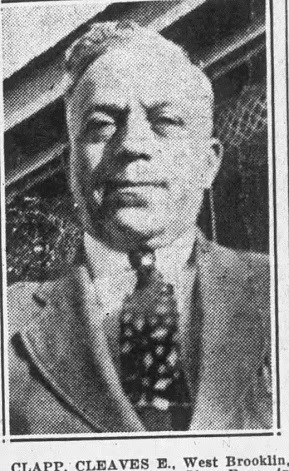
Cleaves Earl Clapp (1889-1959)

From the Kennebec Journal, January 1, 1941.

   Another curiously named member of the Maine legislative session of 1941-43, Cleaves Earl Clapp served alongside Neota Fowles Grady during that session, and, all told, represented West Brooklin for four non-consecutive terms in the state house. Clapp was a lifelong Maine resident and was born in Brooklin, Hancock County, on May 18, 1889, the son of Rodney David and Laura Carter Clapp.
  A student in schools local to Brooklin, Cleaves Clapp married Kate Jones (1891-1964) in 1910 and later had two sons, Cecil Earl (1910-1988) and Waldo Arland (1912-1989). Despite serving four terms in his state's legislature little information could be found on Clapp's life, except notice of his being an automobile salesman, a member of the West Brooklin school board, and a deputy sheriff for Hancock County. Clapp's 1959 obituary also denotes his being a master mason in the Naskeag Lodge of Free and Accepted Masons in Brooklin.
  Elected to the Maine state legislature in late 1940, Clapp took his seat in January 1941 and was named to the committees on the State Prison, and Sea and Shore Fisheries. He would win reelection in 1942, and during the 1943-45 was named to the Pension committee.

From the Bangor Daily News, February 12, 1941.

  In 1948 Clapp was returned to the house for a third term, and during the 1949-51 term was a member of the committees on Aeronautics and Salaries and Fees. He began his fourth house term in 1951 and again sat on the Sea and Shore Fisheries committee. Little is known of Clapp's life after his final term, except notice of a "long illness" that claimed his life on May 20, 1959, two days after his 70th birthday. He was survived by his wife Kate, and both were interred at the Rural Cemetery in Sedgwick, Maine.

From the Bangor Daily News, May 21, 1959.

Saturday, September 3, 2022

Sands Hunt Witherspoon (1859-1926)

From the Maine legislative composite photo of 1905.

  Continuing on our theme of unusually named Maine legislators, we journey to Knox County and Sands Hunt Witherspoon, an obscure resident of North Haven who served a term in the house of representatives early in the 20th century. The last of 10 children, Sands Hunt Witherspoon was born in Rockport on June 1, 1859, the son of  James (1807-1888) and Hannah Greenlaw Witherspoon (1817-1881). Early in his life, Witherspoon removed with his family to North Haven, and his early education was likely obtained there.
   There is a dearth of resources concerning Witherspoon's early life and employment, except notice of his being a fruit grower in Pulpit Harbor, Maine in the early 1890s. In 1904 he announced his candidacy for the Maine House of Representatives and won election that fall. Taking his seat at the start of the 1905-06 session, Witherspoon served a single term and sat on the County Estimates and Towns committees.
  Little else could be found on Witherspoon's life following his term. In 1908 he is recorded as the owner of a grocery and general store in Pulpit Harbor, as well as being a photographer. He died on November 10, 1926, in North Haven and was interred in the Witherspoon family plot at the Fuller Cemetery in that town.

Thursday, September 1, 2022

Neota Fowles Grady (1909-2000)

From the Bangor Daily News, October 25, 1941.

   Joining an all-to-short list of strangely named female political figures, Neota Fowles Grady is the first in a monthlong series of profiles centering on members of the Maine state legislature. Long a leader in Maine education circles, Grady began teaching school in the late 1920s, and in 1939 was elected to the Maine Teacher's Association Committee. This post was followed by service on the State Certification Committee, the presidency of the Maine Department of Classroom Teachers, and was the president of the Kennebec Retired Teacher Association. On the political front, Grady served two terms in the Maine House of Representatives from Lincoln County, and was Whitefield town treasurer. A lifelong Maine resident, Neota Ann Fowles was the daughter of George Ervin (1874-1923) and Minnie Dow Fowles (1876-1947).
  Fowles' early education was obtained at a school in Kings Mills, and later attended the Whitefield High School. A graduate of the Cony High School in 1925, Fowles went on to enroll at the Farmington Normal School, graduating in 1927. That same year she embarked on a teaching career that extended nearly forty years, teaching in schools at Kings Mills, Whitefield, and Carleton. From 1936-1937 she briefly taught at the Windsor and South Windsor schools located in Kennebec County.
  Active in Republican politics in Lincoln County, Fowles served as president of the Lincoln County Branch of Republican Women in the mid-1930s, and in July 1935 was named to its finance committee. She also held seats on both the Board of Governors of the Women's Republican Clubs of Maine and the Whitefield Republican town committee. In the summer of 1938 she announced her candidacy for the Maine House of Representatives from Lincoln County, and in August spoke at a meeting of the Randolph Women's Republican Club. While also promoting her candidacy, Fowles made note that:
"Since women had gained the right to vote it was their duty to educate themselves to vote intelligently on the various issues."
From the Kennebec Journal, July 23, 1935.

  In September 1938 Fowles won her legislative seat, and in a write-up in the Portland Press Herald noted that she would seek a place on the education committee "when those favors are passed out." She took her seat in January 1939 and, at age 29, was one of the youngest members of that session of the legislature. Described as "bright-faced, smiling, alert", Grady was soon named to the committees on education and the library, as well as the committee on sanitariums. During her first term, Fowles served in the additional capacity of secretary-treasurer of the Order of Women Legislators, holding that post into 1940. In 1939 Neota Fowles married fellow Whitefield resident Joseph George Grady (1902-1971), to who she was wed for 32 years. The couple had one son, Alan George (1945-1961), who died unexpectedly at age 16.
  Announcing her candidacy for reelection in 1940, Neota Grady handily won reelection and during the 1941-43 term continued on the education and library committees. After leaving the legislature she served Whitefield as town treasurer from 1943-45 and was a member of the Lincoln County Republican committee. After a decade away from teaching Grady returned in 1950 to teach elementary school in Kings Mill. Nine years later she transferred to the Whitefield school where she taught the fifth grade, and in 1965 was a grade 6 reading teacher and assistant music teacher at the Pray Street School in Gardiner.

From the Kennebec Journal, January 20, 1940.

  In 1970 Neota Grady retired from teaching for nearly forty years and continued an active role in education in her state. Beginning in 1963 she served a two-year term as president of the Maine Department of Classroom Teachers, and two years following her retirement from teaching was elected president of the Kennebec Retired Teacher Association. In 1973 she advanced to the National Retired Teachers Association-AARP Maine State Legislative Committee, which she served on until 1983. From 1975-76 she held the additional role of board chair. 
  Active in the civic life of Whitefield, Grady was a longtime member of the Whitefield Union Church and Helping Hand Society, being church treasurer and organist. She was a seven decade member of the local grange, and was remarked as a talented piano player, playing at various local and county functions. She celebrated her 90th birthday in 1999 and died a month shy of her 91st birthday on July 1, 2000, at a nursing facility in Augusta. She was later interred alongside her husband and son at the Whitefield Cemetery.

Thursday, December 19, 2019

Medor Ewing Louisell (1869-1938), Meader Bly Pinkham (1837-1914)

Portrait from the Manual of the Constitutional Convention of Michigan, 1907.

  Benzie County, Michigan attorney Medor Ewing Louisell had fleeting involvement in Bay State politics with his service as a delegate to the Michigan Constitutional Convention of 1907-08. Born of French descent, Louisell possesses a rare first name, the first such instance of which I've found. Born in Fond du Lac, Wisconsin on May 5, 1869, Medor Ewing Louisell was the son of Joseph and Julia (Balthazar) Louisell. During childhood, Louisell removed with his family to the Dakota territory, and, after several years of residence in that area resettled in Manistee County, Michigan.
  Louisell would obtain his early education in the common schools during the winter months and during the summer months took employment in a local shingle mill. Resolving to better himself, he enrolled at the University of Notre Dame for a three year period and, while working for tuition and board, finished out his studies in 1891 when he graduated from the Manistee High School. Deciding to pursue a career in law, Louisell attended the University of Michigan from 1891-95 and during this period dabbled in journalism for a time, even serving as city editor for the newspaper that evolved into the Manistee Daily News.
  Following his graduation from the university's law and literary departments in 1896, Louisell was offered a teaching position (as a French language tutor) at his alma mater but declined, wanting to focus on law. By 1903 Louisell had established a practice in Calumet, Michigan, and married that year to Calumet native Mary J. Tallon (1875-1957) and later had seven children: Catherine Medora (1904-1991), Paul Jerome (1907-1986), John Henry (1909-1953), James Michael (1909-1975), Wilfred Francis (died in infancy in 1913), David William (1913-1977), and Charles Tallon (1917-1994). 
  During his residency in Calumet, Louisell was named an assistant prosecuting attorney for Houghton County, and after removing to Benzie County, won election as its prosecuting attorney, holding that post from at least 1905-06. In 1906 he was elected as the 27th district's delegate to the Michigan Constitutional Convention that was to be held in Lansing in 1907-08, and during the proceedings was named to the following committees: Arrangement and Phraseology, Education, and Liquor Traffic.
  Shortly after his service at the constitutional convention Medor Louisell removed with his family to Duluth, Minnesota, where he continued to practice law. In 1915 he returned to politics when he announced his candidacy for judge of the municipal court of Duluth, but was defeated. In the next year, Louisell was elected vice president of the French Naturalization Club of Duluth and continued residence in that city until his death at age 69 on August 5, 1938. He was survived by his wife and children and was interred at Duluth's Calvary Cemetery.

From the Duluth Labor World, April 3, 1915.

From the 1893 Maine legislative composite portrait.

  A one-term member of the Maine House of Representatives from Lincoln, Meader Bly Pinkham held the additional post of selectman for that city, and also operated a general store. Born in Lincoln on October 9, 1837, Meader Bly Pinkham was the son of James and Mollie (Bly) Pinkham. A student in schools local to the area of his birth, he entered into the mercantile trade at age 21, operating a general store in Lincoln for many years.
  In June 1857 Pinkham married in Lincoln to Lucy A. Brock (1838-1873), to who he was wed until her death. The couple's brief union produced two daughters, Cora (1859-1948) and Etta Eliza (1867-1963). Pinkham entered local politics with election to the Lincoln board of selectmen and was later appointed as U.S. Postmaster at Lincoln, where he served for nine years. In 1892 he was elected to the Maine House of Representatives, and during the 1893-95 session was a member of the committee on State Lands and State Roads.
  Prior to removing to Bangor from Lincoln, Pinkham served as a trustee for the Mattanawcook Acadamy in Lincoln, serving as board secretary. In his final years, he resided with his daughter in Bangor, where he died on May 3, 1914, aged 77. He was survived by his daughters and was interred alongside his wife at the West Broadway Cemetery in Lincoln.

From the Bangor Daily News, May 4, 1914.

Friday, October 19, 2018

Phidelem Sinai Demers (1887-1973)

Portrait from the Sanford Tribune, April 16, 1959.

  Possessing one of the more exotic-sounding names you'll see on a roster of past Maine state legislators, Phidelem Sinai Demers was a native of Quebec, Canada who, following removal to the United States, began a long career as a pharmacist in York County, Maine. In addition to his chosen vocation, Demers also cultivated a reputation as one of Sanford, Maine's leading citizens, being a past president and treasurer of the Maine Pharmaceutical Association, a member of the Maine State Commission of Pharmacy, and a two-term state representative from York County. 
  Demers' story begins with his birth in Saint-Fortunat, Quebec, Canada on November 11, 1887, being the son of Telesphore (1847-1950) and Henriette (Lamontagne) Demers. During a long life that extended more than a century (he lived to age 102), Telesphore Demers and his wife raised thirteen children and he himself would achieve success in local Canadian politics, serving as mayor of Saint Fortunat and as school board president. Telesphore removed to Maine with his family in 1890 and after a brief residence in Springvale, settled in the town of Sanford, where he resided until his death.
  Young Phidelem Demers would attend "parish and public schools" in Maine and during his youth worked in a drug store. This work would have a lasting effect on Demers, and after deciding upon a career as a pharmacist enrolled at the University of Buffalo's College of Pharmacy. Following his studies, he earned his New York and Maine pharmacy certificates in 1909 and in the following year joined with his elder brother Donat in establishing a pharmacy on Sanford's "east side." Phidelem Demers married in Maine in April 1912 to Laura Brunelle (1886-1947), with whom he had two sons, Edouard (died in infancy in 1914) and Arthur (1916-1998), the latter also becoming a pharmacist.
   After several years of operating a pharmacy with his brother Donat, Demers sold his interest to his brother and in 1914 opened his own pharmacy, which continued until 1916. After the sale of that pharmacy Demers removed to Rumford, Maine to join the Rumford Drug Store, where he was employed until 1919, afterward returning to Sanford to operate his own pharmacy. In 1923 he purchased the Philip Woods Drug Store, which he continued to operate for over three decades.
  Through the following decades, Demers' status as one of York County's established pharmacists saw him maintain longtime memberships in both the York County and Maine Pharmaceutical Associations. His five-decade-long career in his field saw him hold both the presidency and treasurership of the Maine Pharmaceutical Association and was a member of the Cumberland County Pharmaceutical Association and treasurer of the Maine Independent Merchants Legislative Council. Further honors came Demers' way in 1937 when he was given the American Druggist Award for Service to Pharmacy, and in 1947 was appointed by Governor  Horace Hildreth to the Maine State Board of Pharmacy, serving a three-year term. 

From the Sanford Tribune and Advocate, November 30, 1933.

   While distinguished as a pharmacist, Phidelem S. Demers' time in political office is another noteworthy aspect of his life story. He began his political career at the local level, being a member of the Democratic town and county committees. He was first elected as a member of Sanford's school superintending committee in the early 1930s and was later a trustee for the Sanford Water District for over twenty years, first being elected in 1943. In 1934 Demers announced his candidacy for the Maine House of Representatives and in September of that year won the election, polling 3,014 votes. 
  Taking his seat at the start of the 1935-37 session, Demers' first term saw him introduce legislation that would establish a "representative town meeting form of government" for Sanford, as well as an act that changed the name of the Nasson Institute in Sanford to Nasson College. He would win a second term in 1937, polling 3,246 votes, and sat on the committee on Public Health. The 1937-38 term also saw Demers help draft a new Maine state pharmacy law, taking to the floor of the house to outline the bill's benefits, remarking:
"The purpose of this bill is to regulate the practice of pharmacy, to regulate the sale of poisons, to eliminate certain evil practices, which have been a menace to the public health, and to revise and clarify the present apothecary law, so as to make it workable. Due to our very liberal pharmacy laws,  we find variety stores camouflaged to look like drug stores, selling poisons and other dangerous drugs without discrimination."
From the September 10, 1936 Sanford Tribune and Advocate.

   Following his terms in the legislature, Phidelem Demers returned to his work in Springvale and remained active in other Springvale civic organizations, including a stint as president of the Springvale Rotary from 1947-48 and as a trustee for the Springvale Public Library, serving well into the 1960s. He continued service as a member of the Sanford Water District and retired from his pharmacy in April 1964, being feted with a celebratory dinner at a local steakhouse. Widowed in 1947, Demers would remarry three years later to Aurore Brunelle (1900-1987), who would survive him upon his death. Sources also denote Demers as a keen philatelist with an impressive knowledge of American issues and commemorative issues.
  After many years of service to York County at both the local and state level, Phidelem Sinai Demers died aged 85 on June 6, 1973. He was later interred in the Demers family plot at the St. Ignatius Cemetery in Sanford, Maine.

From the Biddeford Saco Journal, April 17, 1964.