Sunday, July 15, 2012

Commodore Perry Vedder (1838-1910), Commodore Perry Meek (1851-1943), Commodore Perry Craig (1869-1933), Commodore Perry Stover (1851-1932), Commodore Perry Thornhill (1858-1948), Commodore Bruce Roberts (1875-1941), Commodore Decatur Dotson (1864-1948), Commodore Daniel Loveless (1866-1945)


  This oddly named New Yorker is one Commodore Perry Vedder, a prominent resident of the town of Ellicottville who was elected to multiple terms in both houses of the New York state legislature between 1877 and 1891. In his younger years, Vedder distinguished himself on the Civil War battlefield, being brevetted as a Lieutenant Colonel. In addition to his political and military service, Vedder also found fame in a variety of business and civic endeavors throughout his native state. I first located the name of Commodore P. Vedder in a 1985 edition of the New York State Red Book that had been discarded from my high school library way back in 2001. Since becoming aware of him over a decade ago, Mr. Vedder has been one of my personal favorite strange political name discoveries, not only for his having a naval title for a first name but also for his being a truly prominent local political figure.
   Commodore Perry Vedder was born in Ellicottville on February 23, 1838, the son of local farmer Jacob Vedder and his wife Margaret Gouverneur. Young Vedder received his first and middle names in honor of "Commodore Perry", which, as it so happens, is the title of two famed American naval commanders. The first, Commodore Oliver Hazard Perry (1785-1819), the "Hero of Lake Erie", gained lasting distinction during the War of 1812, while the other is Oliver's younger brother Commodore Matthew C. Perry (1794-1858), who helped instigate American diplomatic ties and trade with Japan. Despite both of the Perry brother's prominence, Commodore Oliver Perry looks to be the most likely candidate, as his status as a naval hero had been known for two decades before Vedder's birth in 1838.
   Commodore P. Vedder attended the common schools in Ellicottville and during his youth worked as a boatman on the Erie Canal and later went aboard the brig Alert on the Great Lakes. After accumulating enough savings from his various jobs, Vedder returned to Cattaraugus County, New York, and entered the Springville Academy in the late 1850s. During his time at this institution, Vedder taught school in the Cattaraugus area until 1862, when he signed on for service as a private in the 154th Regiment, New York Infantry. He is recorded as serving in this regiment until the close of the hostilities and participating in the battles of Wauhatchie, Lookout Valley, Bentonville, and Chancellorsville. Vedder was captured at the last-named battle and spent nearly two weeks as a prisoner of war in the Libby Prison in Richmond, Virginia. After being paroled in the fall of 1863, he went on to serve under General William T. Sherman on his famed march to the sea from Atlanta and concluded his military service as a Lieutenant Colonel of Volunteers.
   After returning home, Vedder began pursuing the study of law at the Albany Law School and in 1866 was admitted to the state bar. In the following year, Vedder was named as a register in bankruptcy and held this post for eight years. In November 1871 he was elected to his first term in the New York State Assembly as a Republican, defeating Democratic nominee Charles Carey by a "majority of 401." Appointed to the judiciary committee during his second year in the assembly, Vedder was noted as a "man of fine personal appearance and unusually pleasing address, and evidently has a brilliant career yet before him." He continued to serve in the assembly until 1875, and it was in this year that he was elected to a two-year term in the state senate. 


          This portrait of C.P. Vedder appeared in Volume 1 of The Men of New York, published in 1898.

   Vedder's first term in the senate saw him serve as Chairman of both the Committee on Indian Affairs as well as Internal Affairs. He left the senate in 1877 and three years later was appointed by then-Governor Alonzo B. Cornell as New York State Assessor, serving from 1880-1883. Vedder's tenure in the assessor's office was mentioned in the second volume of Genealogical and Family History of New York as one of particular note as "it is asserted that no man ever did more to lighten the burdens of taxation upon those least able to bear them."  In his last year of service as state assessor, Vedder was once again elected to the New York State Senate. Taking office in January 1884, he held a seat on the committee of Taxation and Retrenchment and during his senate service (which extended from 1884-1891), was the author of "The New York state laws taxing gifts, legacies and collateral inheritances". It was also noted that as a result of Vedder's work in the senate "millions of dollars have been paid into the treasury, and a permanent source of revenue has been provided for the state."
   Within a year of leaving the senate, Commodore P. Vedder married Chicago native Genevieve Wheeler in July 1892. This was, in fact, his second marriage, as his first wife, Bettie Spires, had died in Ellicottville in 1884. Commodore and Bettie Vedder are also mentioned as having a son named John Vedder (born 1868) who predeceased them both in 1882 at age 14.

            Commodore P. Vedder as he appeared in the Genealogical and Family History of New York.

    Even after leaving the senate, Vedder continued to be invested in Empire State political and business circles. In 1894 he was named as a delegate to the New York State Constitutional Convention and also held the presidency of fourteen corporations in and around the state, including the Bank of Ellicottville (president for 20 years), the State Bank of Norwood (president for 24 years), the Falls Electric Power and Land Company, the New York and New Jersey Ice Lines, and the Elko Milling, Mining and Manufacturing Company of Randolph, New York. In addition to his aforementioned business interests, Vedder is also mentioned as being a major figure on the New York social scene, holding a membership in the Holland Society for over two decades, was an active Mason, and was a member of both the Republican Club and Lawyer's Club of New York City.
   After many years of service in New York public life, Commodore P. Vedder died on December 24, 1910, in his room at the Hotel Majestic in New York City. The 72-year-old Vedder had been seriously ill for only a few hours and the cause of death (as listed in his obituary below) was heart disease. 


                      Vedder's obit as it appeared in the December 25, 1910 edition of the New York Herald.


   Earlier today I (as well as the Strangest Names In American Political History book) made a visit to Commodore P. Vedder's final resting place in Ellicottville. After some searching, his impressive monument was found below the sloping terraces of the Sunset Hill Cemetery. And now for some photos from today's visit!


  As one can see by the above photograph, Vedder's tombstone is one that certainly befits a state legislator, businessman, and military figure! It's also quite nice to see that someone still cares enough about Vedder's legacy to plant flowers in the large urns on either side of his stone. Although no notice is given as to his service in the senate or assembly, a GAR marker and American flag are prominently situated next to his small burial stone located nearby.


   Getting at Vedder's gravesite also proved to be an adventure in and of itself, as one has to descend down two sloping terraces to stand in front of it. As it had rained earlier today, the ground was nice and slippery, making it even more fun on the walk down!


  This is Vedder's actual gravestone, located about ten or so feet in front of the large burial marker shown in the above photographs. Next to Vedder's gravestone are those of his wife and son, as well as other later descendants of his. Also buried in the Sunset Hill Cemetery is William Grant Laidlaw (1840-1908) a native of Scotland who served as a U.S. Representative from New York from 1887 to 1891.

  In addition to the very active life of Mr. Vedder, there are also four other politicians with the unusual name Commodore Perry. Like the man profiled above, these men were all named in honor of Commodore Oliver Perry. Read on to find out more!


    Born in Maysville, Missouri on May 12, 1851, Commodore Perry Meek would find distinction in his adopted home state of Wyoming, serving terms in both houses of the state legislature. Meek attended schools in his native Maysville and spent the majority of his formative years helping out on the family farm.
   In 1871 the then twenty-year-old Meek removed to Cheyenne, Wyoming and for several years engaged in the transport of freight to various towns on the Wyoming frontier. In the late 1870s and 80s Meek also engaged in mining, ranching and the raising of cattle, eventually becoming the proprietor of a large ranch and owner of "sixteen hundred acres of deeded land and over one thousand head of cattle." 
   Meek married in 1909 to Ms. Emma Brown, a native of Illinois. The two were married for over twenty years until she died in 1930 at age 63, and the couple is recorded as being childless. Commodore P. Meek made the jump into state politics in November 1912 when he won election to the Wyoming State House of Representatives from Weston County. Meek served one term in the legislature that concluded in 1915, and in 1919 was elected to the Wyoming State Senate. During his senate service, he held a seat on the committees on Prohibition and Railroads and Transportation and later chaired the committee on Stock Raising and Stock Laws.
   After leaving the senate in 1923, Meek returned to his earlier ranching and business interests in his native Weston County. He died at age 92 in 1943 and was buried in the Greenwood Cemetery in Upton, Wyoming.


  This obscure man is Mr. Commodore Perry Craig, a native of Pleasants County, West Virginia who served terms in both the state house of delegates as well as the senate. Craig was born in Tyler County, West Virginia on August 1, 1869, the son of James and Edith Craig. Craig received a common school education and as a youth was employed as a clerk in a general store in West Virginia. Craig eventually moved to Liverpool, Ohio during his twenties and found employment as a stone paving and contracting bookkeeper. 
  Shortly after returning to Pleasants County, Craig began pursuing the study of law. In 1894 married Cora Alice Wilson (1874-1944), with whom he had five children: Iva, Pearl, Vesta, Grace (1906-1967), and Commodore Perry Jr. Within a few years of his marriage, Craig was elected as the Prosecuting Attorney for Pleasants County, serving in this office until 1900.
  In 1904 Craig won election to the West Virginia State House of Delegates and continued to hold his seat until 1908 when he became a State Senator. In addition to serving in the senate, Craig also held the chairmanship of the Pleasants County Council from 1908-1910. Other than the preceding information, little else could be found regarding Craig's life. He died at age 65 on November 26, 1933, and was subsequently buried in the IOOF Cemetery in Saint Mary's, West Virginia. The rare portrait of him above was located in a West Virginia State Legislative manual, published during Craig's time in the state legislature.


 From the Raleigh Register, June 12, 1932.

   Following on the heels of Commodore Perry Craig, Commodore Perry Stover was another man with this odd name who was a member of the West Virginia State House of Delegates. A lifelong resident of West Virginia, Stover was a longtime educator in the county of Raleigh, where he served two terms as superintendent of schools.
  Born in Raleigh County on December 21, 1851, Commodore P. Stover was the son of Silas and Mary Jane Workman Stover. He married on July 28, 1873, to Martha A. Thompson (1855-1941) with whom he had 11 children, Commodore (born 1873), Abagail (1874-1950) Van Buren (born 1876), Virginia Lee (1877-1968), Everett (1880-1973), Morrison (born 1882), Silas (1884-1966), Robert Hugh (1886-1955), Philip (1888-1912) Alethia (born 1890) 
and Mary (born 1894).
  Commodore P. Stover embarked upon a career as a school teacher early in his life and is recorded as following this route for many years afterward. He served two terms as Raleigh County superintendent of schools from 1885-1889 and was also entrusted to hold a number of county offices, serving as county assessor,  justice of the peace, and deputy United States Marshal. In 1895 Stover won election to the West Virginia State House of Delegates and took his seat at the beginning of the new year's legislative term. 
  After leaving the legislature in 1898 Commodore Stover returned to Raleigh County, where he died on May 25, 1932, at age 81. He was later interred at the Workman's Creek Cemetery in Clear Creek, West Virginia.

                                                                       From the "Local and National Poets", 1892.

  Louisiana attorney Commodore Perry Thornhill is yet another man blessed with the unusual name "Commodore Perry". A practicing lawyer in the parish of Caldwell for many years, Thornhill served as District Attorney for Louisiana's Fifth District for four years and in 1913 was selected as a delegate to the Louisiana State Constitutional Convention.
   Born in Caldwell Parish on June 13, 1858, Commodore P. Thornhill was the sixth-born son of John and Matilda Blackburn Thornhill. Commodore's early education occurred in schools local to Caldwell Parish and in 1881 he entered into the study of law. He was admitted to the bar in 1884 and would establish a practice in the city of Columbia. In May of that year, he was appointed to the police jury of Caldwell Parish and sometime later became that body's president. Thornhill would also serve a short period as Mayor of Columbia (his dates in office being unknown), but later resigned due to "his duties as an attorney were too pressing to admit of his time being divided."
   Commodore Thornhill married in Caldwell in 1889 to Eva Bridger (1868-1952) and the couple would become parents to two children, John Bridger (1890-1978) and Marion (1892-1945). In 1907 Thornhill was elected as District Attorney for Louisiana's Fifth District (comprising the parishes of Caldwell, Winn, and Jackson) and served in this capacity from 1908-1912. In 1913 he served as a delegate to the Louisiana Constitutional Convention and sat on the committee on the Law during his time at the convention.
   While active as an attorney and public official Commodore Thornhill gained additional notoriety as a writer of prose, having a number of his poems published in periodicals of the time. Three of these poems (entitled "A Reflection", "Night" and "Extract") were published in their entirety in the 1893 edition of the "Local National Poets of America" and can be read here. 
   Following his time at the Constitutional Convention Thornhill continued to reside in Caldwell Parish, dying there on September 7, 1948, at age 90. He was survived by his wife and son and was interred at the Columbia Hill Cemetery in Columbia, Louisiana.
  

   This stern-looking individual is Commodore Bruce Roberts, an Indiana resident who found his political and business fortune in Montana. Like the men profiled above, Roberts was endowed with the unusual first name "Commodore" but unlike the four men before him was not named in honor of Commodore Perry.
  Born in Fulton County, Indiana on December 9, 1875, Commodore B. Roberts was the firstborn child of George and Lovina Roberts. "C.B." or "C. Bruce" (as most sources list him) attended school in the town of Knox, Indiana, and as a youngster found employment driving a wagon and working in a grocery store. As an adolescent, he worked as a traveling salesman for a grocery house based out of Ft. Wayne, Indiana, and later returned to Knox to begin a venture in the restaurant business. Roberts eventually made his way to Chicago, Illinois in the 1890s, where he found work as the chief clerk for the Nickel Plate Railway Company.
  Roberts removed to Montana in 1902 and soon after his arrival became engaged in the loan and insurance business. He continued in this profession until 1909, whereafter he began an interest in the manufacturing of lumber. Over the succeeding years, Roberts built up a substantial sawmill and logging railroad for his business and logged many thousands of acres of timber throughout Montana. In 1903 he married an Englishwoman named Annis Elliott, and one son was born to the couple, Elliott John Roberts, in 1904. Commodore and his wife later adopted a second child, Gladys Lucile (1913-1995) in December 1913.
  While still actively involved in the lumber business, Commodore Roberts ventured into banking, founding and serving as the vice president of the Bank of Kalispell, Montana, and later purchasing the Cascade Bank located in Great Falls. During this time he was also elected to the Montana State Senate, where he served from 1915-1919, representing the county of Lincoln.
  Roberts continued to be actively involved in business and fraternal organizations during his later years, serving as chancellor commander of the Knights of Pythias as well as being the treasurer of the Great Falls Lodge of Perfection. C. Bruce Roberts died in La Porte, Indiana on June 3, 1941, at age 66 and was buried in the Pine Lake Cemetery in that town. His wife Annis survived him by two decades, dying in Connecticut in January 1963 at age 82. The portrait of Roberts shown above was featured in the third volume of the 1921 work Montana, Its Story and Biography, edited and compiled by Tom Stout.
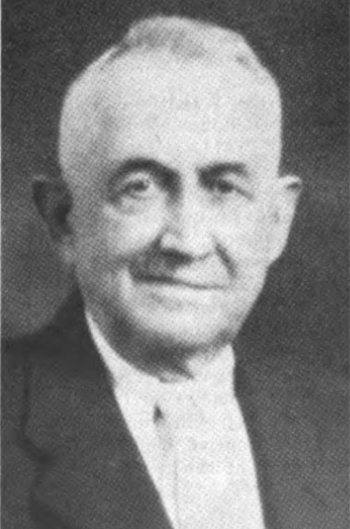
Portrait from the West Virginia Blue Book, 1933.

  Lifelong West Virginia resident Commodore Decatur Dotson was elected to one term in his state's senate towards the end of the 19th century and nearly four decades later was returned to government service when he was selected as Sargent-at-Arms of the West Virginia State Senate. The son of Richard and Elizabeth (Deem) Dotson, Commodore Decatur Dotson's birth occurred in Wood County, West Virginia on January 13, 1864. An alternate year of birth of 1867 is listed in his biography in the 1933 West Virginia Blue Book and is believed to be an error on the part of the compilers, as genealogical data (as well as his tombstone) record the year 1864.
  A student in the public schools of Wood County, Dotson married in 1900 to Mabel Tyler (1873-1942). The couple's four-decade union was childless and for a good majority of his life, Dotson was engaged in the steamboat and river contracting business in his state. His 1933 Blue Book biography also denotes his involvement as a sand, gravel, and real estate dealer. Elected to the state senate in 1896, Dotson would serve one four-year term (1897-1901) and would sit on the committees on Banks and Corporations; the Judiciary; Privileges and Elections; and Railroads.
    Following his term, Dotson served as chairman of the Wood County Democratic Executive Committee during the 1920s and in 1933 was named Sargent-at-Arms of the West Virginia Senate. He would briefly serve in this role, as he resigned that same year to accept the post of Chief Appraiser for the Home Owner's Loan Corporation. Widowed in 1942, Dotson survived his wife Mabel by six years, dying aged 84 on September 26, 1948, at his home in Parkersburg. Both he and his wife were interred at the Parkersburg Memorial Gardens after their deaths.

From the Beckley Raleigh Register, Sept. 28, 1948.

From the 1941-42 Tennessee State Senate composite photo.

    A leading public figure in Maury and Lewis County, Tennessee, Commodore Daniel "C.D." Loveless was a longtime banker and farmer who began his political career late in life, first winning election to the Tennessee state senate at age 66 in 1932. He would subsequently win reelection to four further terms in that body, and at the time of his retirement was remarked as having represented his district in the senate longer than any previous senator. Born in Hickman County, Tennessee on February 21, 1866, Commodore D. Loveless was the son of Peter Riley and Nancy Loveless.
  Loveless' early education was obtained in the county of his birth and by 1891 had removed to Wayne County, where he was engaged with the Aetna Furniture Company. In the mid-1890s Loveless married Mary Jane Smith (1870-1939), and the couple's five-decade marriage saw the births of at least four children, including Pearle Lee (1897-1968), Carlie Commodore (died in infancy in 1901), Josephine (1903-1971), Malcomb Frelon (1905-1941), and F. Ward Loveless.
  In 1898 Loveless resettled in Maury County and in the succeeding years gained prominence through various banking interests, including being a founder and director of the Hohenwald Bank and Trust Company. In addition to that bank, Loveless held directorships in the Commerce Union Bank and the Middle Tennessee Bank located in Columbia, Tennessee. Purchasing a farm at Spring Hill in Maury County in 1915, Loveless would reside there until his death and was also a member of the Spring Hill Masonic Lodge.
  Loveless began his political career in 1932 with his election to the Tennessee Senate, where he served for five consecutive terms (1933-43). During his final term, Loveless saw his many years of public and political service acknowledged when the state Department of Highways named a bridge (the Commodore D. Loveless Bridge in Maury County) in his honor. He retired from the senate in 1943 due to health concerns and died two years later at a Nashville hospital on January 29, 1945. He was later interred at the Rose Hill Cemetery in Columbia, Tennessee. 

From the Nashville Tennessean, January 30, 1945.

Wednesday, July 11, 2012

Armour Boot (1903-1984)

                                                           From the Iowa State Red Book 1965-1966 edition.

   Possessing one of the more humorous names that will be posted here on the site, Armour Boot represented Marion County in the Iowa State House of Representatives from 1965 to 1967. Sadly, like Brownrigg H. Dewey (profiled a few days ago) little exists online in regards to Boot's life and term in the legislature. The majority of the facts contained herein were found in the Iowa State Red Book edition of 1965-67, which contained the picture of Boot shown above.
  Armour  Boot was born in Jasper County, Iowa on July 9, 1903, the son of William B. (1869-1943) and Aaltje (Alice) Reitveld Boot (1872-1933). Boot received his education in the common schools of his native county and on December 24, 1929, married Pella, Iowa native Susie Zwank, with whom he had one daughter, Nola Boot, born in 1931. 
  From the few sources that mention him, the majority of Armour Boot's life was centered mainly in the private sector, and he is recorded as having been a farmer for a good majority of his life. Boot was later employed in the selling of farm implements for several years, and one particular source (a small write-up in a November 1962 edition of the Pella Chronicle) makes note of him being a stockholder in the Vander Zyl Bros. Implement Company. In addition to his farming and business pursuits, Boot was also active in Marion County civic affairs, serving as a member of the Pella City Council and the local school board. An Iowa legislative journal (published shortly after Boot died in 1984) also notes that he was a member of the First Reformed Church of Pella both before and after his service in state government.

Armour Boot during his first legislative candidacy, from the Nov. 2, 1961 Pella Chronicle.


This article on Armour Boot's campaign appeared in an April 1964 edition of the Pella Chronicle.

   Armour Boot first became active in politics during his tenure as Pella city councilman, but it wasn't until 1961 that he launched a campaign for the Iowa State House of Representatives. He was unsuccessful in his initial bid, losing that November to Republican incumbent Elmer Vermeer (1920-1989), who garnered 4,745 votes to Boot's 3,618. Vermeer retired from the Iowa legislature in 1964 after a decade of service and in November of that year, Boot won election to Vermeer's old seat. After taking his seat in January 1965, Boot was named to the following legislative Committees: Commerce, Conservation, and Ways and Means. Boot served but one term in the legislature, as he was defeated in the September 1966 Iowa Democratic primary by another Marion County native, Lerlia Galvin.
   Little else could be found on Armour Boot's life after his time in the legislature. He died at the Pella Community Hospital on February 15, 1984, aged 80, and was survived by his wife of nearly fifty-five years, Susie Zwank Boot. Susie Boot lived to become a centenarian, dying on April 5, 2006, four months after her 100th birthday. Mrs. Boot is listed in her obituary as having attended "many political functions" with her husband, both during his time as a councilman and later as a legislator.

Boot's obit from the February 22, 1984 Pella Chronicle.

Monday, July 9, 2012

Posey Green Lester (1850-1929), Posey Thornton Kime (1895-1958), Posey Wilson Cooper (1902-1951), Posie James Hundley (1888-1961)


    Today's profile is one of particular note, as it centers on Posey Green Lester, certainly one of the most obscure Congressmen on record. This funny-named man represented Virginia's fifth district in the U.S. House of Representatives for two terms, serving from 1889-1893, and the following passages on his life are notable as it marks the first time that a picture of Mr. Lester is available online, and quite a bit of searching had to be done to locate one! An explanation as to where this rare picture originated from will be provided at this article's end, and we'll begin with the birth of Mr. Lester, which occurred in the town of Floyd, Virginia on March 25, 1850.
   Lester was one of nine children (five sons and four daughters) born to William Terry and Mary Amanda Simmons Lester. He is listed as attending schools in his native Virginia, and in his youth is mentioned as being engaged as a vocal coach and literary teacher. He was called to religious work early in his life and joined the Primitive Baptist Church in 1873 at age 23. It wasn't long before he began to preach in this church and in October 1876 was ordained as a minister. Lester's obituary gives note that he "traveled and preached in twenty-one of the states, and in Ontario, Canada, traveling as much of 13,000 miles in a single year", and in an earlier newspaper article on his life, it is mentioned that during his travels he made use of "nearly all manner of vehicle of conveyance from a dump cart to a steamboat to a railway car."
    Lester began branching out from his ministry into the realm of publishing in the early 1880s, becoming associate editor of Zion's Landmark, a religious periodical based out of Wilson, North Carolina. He became editor-in-chief of that newspaper in 1920 and continued in that post until his death.
   In 1888 Lester was nominated "without his solicitation, and in his absence" for the U.S. House of Representatives, and it is worthy to note that he had never held any interest in pursuing political office. Despite never having sought public office, Lester went on to defeat Republican nominee John D. Blackwell that November, 14, 417 votes to 13, 044, and took his seat at the start of the 1889-90 session. An article on Lester's election to Congress (published in the Pittsburgh Dispatch) relates that he was the only clergyman serving in the House and that he was also "the tallest man in the House, standing 6 feet 2 inches in his stockings, and weighs 205 pounds." This article goes on to state that Lester's "voice conquers space with terrific volume and force, while it really is very musical." 

An article on Lester's renomination, from the August 29, 1890 Richmond Times.

   Lester was reelected to the House in November 1890, defeating Republican candidate S.C. Adams by a substantial margin, 10, 569 votes to 1, 360. During his two terms in Congress Lester served on the Committees on Railroads and Canals, the Committee on Expenditures in the Department of Justice, and the Committee on Alcohol and Liquor Traffic. He refused to be a candidate for a third term in 1892, preferring to return to his ministerial work in Virginia.
   After retiring from Congress, Lester served as the moderator and clerk of the New River Primitive Baptist Association and later held the post of President of the People's Bank of Floyd County for over two decades. In June 1898 he married Emmette Harris, the daughter of one of his fellow church elders. The Lester's are recorded as having three children, Posey Green Jr. (1899-1981), Masten Harris (1900-1970), and Annie Mae (1903-1983). Posey and Emmette were married for three decades and continued in active church work until his death at age 78 on February 9, 1929, in Virginia. Emmette Lester survived her husband by several years, dying in 1937 at age 72, and both were buried in the Evergreen Burial Park in Roanoke, Virginia.
   The rare portraits of Mr. Lester shown above are worth mentioning, as it marks the first time that I've actually seen a portrait of him. The first portrait appeared in a December 1889 edition of the Pittsburgh Dispatch, and this newspaper also gives an excellent write-up on Lester's life, as well as his church work. For many years Lester remained one of the "faceless" politicians I'd happened across, and it seemed as if I'd never locate a picture of him. The Library of Congress website Chronicling America (which is entirely devoted to archived newspapers from across the United States) came to my rescue in that regard, and I am extremely happy to have discovered it!

        This obituary for Posey G. Lester appeared in the Danville, Virginia Bee on February 12, 1929.

Posey T. Kime, from the Muncie Post Democrat, November 16, 1934.

   A longtime attorney based in Evansville, Indiana, Posey Thornton Kime would go on to a distinguished career as a jurist in the Hoosier State, serving several years on the Indiana State Appellate Court. Born on August 6, 1895, in Petersburg, Indiana, Posey T. Kime was the son of John and Effa Posey Kime. Bestowed his mother's surname "Posey" as his first name, Kime would be a student in the Petersburg public school system and was a veteran of the First World War, serving in France.
  Kime went on to attend Purdue University and in 1922 graduated with his law degree from the Indiana State University Law School at Bloomington. In his small biography in the 1922 Arbutus Yearbook, Kime is recorded as being a member of the yearbook staff and the track team. He also was President of the Senior Law Class and the Gamma Eta Gamma fraternity. Posey Kime married on June 21, 1920, to Marguerite Anne Bollenbacher (1893-1990), with whom he would have one daughter, Helen. After obtaining his law degree he established a law practice in Evansville, and for several years afterward was a member of the law firm of Kime and Meyer.
   In 1930 Kime made his first foray into Indiana political life, announcing his candidacy for the Indiana State Appellate Court's First Division. He would win election to that court that November and would serve on the bench until stepping down in October 1938. Kime's resignation from the court came about due to his accepting the appointment of chief attorney for the Federal Power Commission in Washington. Kime's tenure with that agency extended until 1941 when he became affiliated with the U.S. Justice Department's Anti-Trust division. His time in that department saw Kime "prosecute some of the top ant-trust cases" in the country, and in 1946 journeyed to Japan to aid American forces in drafting "a set of anti-trust and trade regulatory laws for the newly 'democratic country.'"
   An active Mason of many years standing, Kime achieved the 33rd degree in September 1952 and died in Washington, D.C. on June 8, 1958, at age 62. He was later interred at the Walnut Hill Cemetery in Petersburg, Indiana. He was survived by his daughter Helen and wife Marguerite, who died aged 97 in 1990.

Portrait from the Evansville Courier, January 3, 1952.

From the 1943-44 Indiana legislative composite.

  Although he lacked length of years (he died aged 49 in 1951), Posey Wilson Cooper carved a notable career for himself in his native Indiana, being at various times a druggist, one-term state representative, and candidate for the state senate. Although little information could be located on his life online, his obituary (published in the August 15, 1951, Jeffersonville Evening News) helped significantly when it came to compiling this article!
  The son of William Jonathan and Mattie B. (Gray) Cooper, Posey Wilson Cooper was born in Winslow, Indiana on March 13, 1902. Little is known of his early life, except for his becoming a druggist during young adulthood and operating a pharmacy in Austin, Indiana for several years. In January 1929 he married in Scott, Indiana to Helen J. Wells, with whom he had two sons, Wilson J.  and Lennox Joseph (1931-2003). 
  Following his removal to Floyd County, Indiana, Cooper operated drug stores in New Albany and Sellersburg and in November 1942 was elected to the Indiana House of Representatives from Clark County. His victory that November saw him defeat Democrat Frank W. Carr by one vote, "the closest legislative race in Clark County's history." During the 1943-45 session, he sat on the house committees on Fees and Salaries, Legislative Apportionment, Public Morals, Roads, and State Medicine and Public Health, and in November 1944 was defeated by Democrat Elmer Hoehn.
   Cooper would attempt one further run for public office in 1950 when he announced his candidacy for the Indiana state senate, and in November was defeated by Democrat Warren M. Martin, who polled 9,549 votes to Cooper's 7, 116. 
  Less than a year after his Senate defeat, Posey Cooper died unexpectedly, having succumbed to a "series of internal hemorrhages resulting from a stomach ulcer" at a hospital in Boston, Massachusetts. Several days prior to his death, Cooper and several friends had undertaken a fishing trip to Maine, and sometime later had been afflicted by the first hemorrhage, necessitating an emergency light to a Boston hospital. Cooper's family would later make it to his bedside shortly before his death on August 15, 1947, aged just 47. Following his body being flown back to Indiana, Posey W. Cooper was interred at the Fairview Cemetery in New Albany. 

From the Jeffersonville Evening News, August 15, 1951.


From the August 8, 1923 edition of the Danville Bee.

   Another Virginian blessed with this rather "flowery" first name is Mr. Posie James Hundley of Pittsylvania County. A prominent attorney and one-term member of the Virginia House of Delegates, Hundley was born in Sandy River, Virginia on September 28, 1888, a son of John Thomas (1852-1932) and Christian Ada Gravely Hundley (1860-1937). His education was gained at the Leaksville-Spray Institute and went on to study law at Richmond College, graduating in 1912. Hundley would also attend Washington and Lee University, graduating around 1913.
   Following his graduation from Washington and Lee, Hundley opened a law practice in the city of Danville in 1913 and two years later became a candidate for commonwealth attorney for Pittsylvania County. Hundley was unsuccessful in his attempt, losing to the Republican nominee Hughes Dillard. Following his loss, Hundley won a seat in the Virginia State House of Delegates from Danville and served during the legislative session of 1918-1919. During his brief time in the legislature, he held a seat on the committees on the Courts of Justice, Federal Relations and Resolutions, Officers and Offices at the Capitol, and Public Property.
  After leaving the House of Delegates in 1919 Hundley became connected with the Cooperative Marketing Association, serving as its local counsel for a time. In 1923 he ran once again for Commonwealth's attorney for Pittsylvania County and was successful, defeating opponent D.T. Williams with a lead of 732 votes. In December 1930 he married Ruth Etta Cashion (1897-1978) and later had two sons, Posie James Jr. (born September 9, 1932) and John Thomas (born December 23, 1934).

From the Danville Bee, March 4, 1945.

   Posie Hundley served a total of eight years as the commonwealth's attorney and in 1944 was a Rationing Board member. In the following year, he re-entered political life when he became a candidate for the Virginia House of Delegates. Running on a platform of "Experience, Character, and Ability",  Hundley's candidacy was highlighted in the March 3, 1945 edition of the Danville Bee, which also notes that he spoke twice on radio station WRTM Danville in regards to his campaign.
   Hundley's March 1945 candidacy for the House of Delegates ended in a defeat at the polls. In addition to public service, Posey Hundley maintained memberships in several Pittsylvania-based fraternal organizations, including the Junior Order of American Mechanics, the Improved Order of Red Men, and both the Masonic and Elks Lodges. He passed away in Danville on November 27, 1961, at age 74 and was survived by his sons and his wife Ruth, who died in 1978 aged 81. Both were interred at the Chatham Burial Park in Chatham, Virginia. Hundley's first name is also spelled as "Posey", but as his gravestone gives the spelling listed in the introduction to his article here, I've presumed that to be the correct one.

Sunday, July 8, 2012

Stogdell Stokes Staples (1859-1949)

From Portraits and Biographies of Members of the Pennsylvania Legislature, 1895.

   An obscure 19th Pennsylvania legislator, Stogdell Stokes Staples further distinguished himself in the business sector of Luzerne County. He was born in Stroudsburg, Pennsylvania on March 7, 1859, the son of Richard S. (1818-1893, a Pennsylvania state representative from 1872-73) and Mary (Thompson) Staples (1828-1900). Young Stogdell studied in both public and private schools, attending a seminary in Claverack, New York, and later attended the Wyoming Seminary in Kingston, Pennsylvania.
   While still a young man, Staples is recorded as helping his father publish the Monroe Democrat in 1878, and after a year in publishing moved to Trenton, New Jersey. Once settled, Staples found employment at the Trenton China Works, and would later serve as the Superintendent of that company for four years. In the mid-1880s he returned to Pennsylvania, and in 1885 purchased the Luzerne Ochre Manufacturing Company. A portrait and biographical souvenir of the Pennsylvania legislature (published in 1895) notes that Staples was "given immediate management" of the plant, and he later became president of this business, as well as holding "a half interest in its enterprise". This business is also noted as "furnishing material to four-fifths of the oil-cloth manufacturers in the country."
  Staples married in March 1886 to Stroudsburg native Hattie Raubenald, and it is unknown at the time of this writing if any children were born to them. While his business exploits are of note, Staples also began seeking local political office, eventually winning election as Burgess of White Haven, Pennsylvania for two terms. He would later be named as Postmaster of the Borough of Moosehead and was still the incumbent in this post at the time of his election to the Pennsylvania State House of Representatives.
   Staples was elected as a Democrat to the Pennsylvania legislature in November 1894, defeating Republican candidate Ellsworth L. Riley by only fifty-two votes! Two other candidates (representing both the Prohibition and People's parties) also ran for this seat, and the blurb featuring those election results has been posted below.


   Staples's election to the legislature is recorded as a "great triumph in view of the demoralized condition of the Democratic party" and during his one term in the legislature held a seat on the following committees: Congressional Apportionment, Corporations, Insurance, Iron and Coal, Mines and Mining, Railroads, and Rules. His two-year term was characterized by the earlier mentioned legislative souvenir as one of "close attention to the details of lawmaking, and displayed to advantage his unusual business qualities". Staples would also take a firm stand against a proposal for the establishment of a new county in Pennsylvania called Quay (named after Matthew Quay, then serving in the U.S. Senate), which was later shot down by a house vote of 92 to 82.

Stogdell Staples in old age, from the Wilkes-Barre Record, April 13, 1949.

  After the conclusion of his term in January 1897, Staples would lose a 1900 race for state representative by a wide margin and continued prominence in his region well into his eighties. From 1914-1919 he served as U.S. Postmaster of White Haven, and in 1917 partnered with G. Robert Baetz and Robert Teel to establish the White Haven weekly newspaper. In the mid-1930s Staples was appointed to a vacant seat on the White Haven borough council. Several months prior to his death he suffered a fall at his home in White Haven, and in March 1949 celebrated his 90th birthday. He died a few weeks later on April 12, as a result of the fall he'd suffered. Staples was preceded in death by his wife Hattie in 1946 and both were interred at the Stroudsburg Cemetery.

From the Wilkes-Barre Daily Record, April 13, 1949.
  
A visit with Stogdell Stokes Staples at the Stroudsburg Cemetery

 In a postscript to the seven-year-old article above, I was able to visit and photograph the gravesite of Stogdell S. Staples in Stroudsburg on September 15, 2019. After twenty or so minutes of searching by car and on foot, the Staples plot was found. Buried beneath an unassuming, modest headstone, no mention is given on this stone to Staples's assembly service or business successes. Buried next to him is his wife Hattie, and behind their stones are the oblong gravestones belonging to Staples' parents  Richard and Mary, the former having served a term in the Pennsylvania legislature in the 1870s. And now some photos from the trip!


September 15, 2019.

Saturday, July 7, 2012

Brownrigg Hefferron Dewey Jr. (1917-1992)


    Outstandingly named Texas state representative Brownrigg Hefferron Dewey Jr. is proof that oddly named political figures weren't just confined to the 19th and early 20th centuries. Nicknamed "Browny", Mr. Dewey served a decade in the Texas legislature, representing Brazos County from 1953-1963. Finding information on B.H. Dewey (as some sources refer to him) has proven to be quite difficult, and, when one considers that he died in fairly recent times, the distinct lack of biographical information on him comes as quite a surprise.
    B.H. Dewey was born on December 16, 1917, in Wilmington, North Carolina, being one of three children born to Brownrigg H. Sr (1892-1980) and Esther Dewey. Sometime following their son's birth the Dewey family moved to Texas, where "B.H." attended Texas A & M University. He was later a graduate of the University of Texas Law School and was admitted to the state bar in 1941. 
   A veteran of WWII, Dewey served in the U.S. Army, and following his service returned to Brazos County to practice law. The Big Spring Daily Herald gives note that Dewey served as the secretary-treasurer of the Brazos County Democratic Executive Committee for several years and later made two unsuccessful attempts for a seat on the Bryan city council. Dewey was also an alternate delegate to the 1948 Democratic National Convention from Texas. He was first elected to the Texas State House of Representatives in November 1952 and is mentioned by the Herald as defeating four opponents in his bid for a legislative seat.
    After taking his seat in January 1953, Dewey was named to the following House committees: Appropriations, Congressional and Legislative Districts, Conservation and Reclamation, Privileges, Suffrage and Elections, and lastly, Public Printing. Dewey was reelected to the Texas House of Representatives in 1955, 1957, 1959, and 1961, and during his final term was appointed to the Executive Board of the Southern Regional Education Board. A brief write-up on this appointment was featured in the 1962 edition of The Alcalde and is posted below.


   In addition to the aforementioned appointment, B.H. Dewey also was selected as the President of the Brazos County Bar Association in 1961, where he served for an indeterminate period. He continued to be a very busy man during his later legislative terms, holding the chairmanship of the Appropriations Subcommittee on Education, the Committee on Examination of Comptroller's and Treasurer's Accounts, and Representation Before the Legislature. Dewey's last term in the legislature concluded in January 1963 and in the Democratic primary of 1964 was an unsuccessful candidate for reelection to the legislature. Dewey was dubbed the "Little Bull of the Brazos" during his tenure in the statehouse and in regards to his curious name, remarked: "Call me B.H., nobody knows about Hefferron."
   Several following the conclusion of his time in state government Dewey was elected as Justice of the Peace for Precinct 4 of Bryan, Texas, and he is noted in a 1991 Bryan Eagle newspaper as holding this post for nearly 27 years. Other than the preceding information, little else could be found that gives note to Dewey's life and political career. The Texas Legislative Reference Library's website (where the above picture of him was found) notes that Brownrigg Hefferron Dewey died on November 18, 1992, at age 74. A lifelong bachelor, a burial location for Dewey remains unknown at this time.

B.H. Dewey, from the May 1994 Texas Bar Journal.
                                                                

Thursday, July 5, 2012

Melbourne Haddock Ford (1849-1891)


  This well-dressed gentleman is Melbourne Haddock Ford, a U.S. Representative from Michigan in the late 1880s. Despite his untimely death at age 41 in 1891 this oddly named politician managed to carve quite a career for himself in the public forum, serving at various times as an attorney, Michigan State legislator, state Democratic Committee chairman and U.S. Representative.
   Melbourne H. Ford was born in Saline, Michigan on June 30, 1849, one of five children born to Theron Ford and his second wife Amelia Burke.  The Ford family removed to Lansing, Michigan when Melbourne was ten and here he attended local schools. Ford continued his education at the Michigan State College of Agriculture, and in 1864, the then fifteen-year-old Ford enlisted in the Navy and was later promoted to midshipman at the U.S. Naval Academy at Annapolis. He left the Academy in 1868 (a memorial resolution on his life gives his reason for leaving as an "affection of the eyes") and shortly thereafter returned to Lansing. Here he became employed as a clerk in a drugstore and eventually found his niche as a stenographer. The Congressional Memorial address on his life notes that Ford "grew to be an expert and one of the most successful shorthand writers in the country" and was "long engaged as a stenographer in the higher courts of Michigan."
   While still employed as a stenographer, Ford studied law and was admitted to the Michigan State Bar in 1878. Also around this time, Ford married Newport, Rhode Island native Mary Carr, with their union producing three children, Kate Huntington, Thomas Burke (1878-1959), and Arthur Melbourne. After beginning his law practice, Ford authored a legal textbook, entitled "Ford's Legal Analysis", mentioned as being a "small but standard legal work". In 1885 he was elected to his first political office, that of Kent County's representative in the Michigan State Legislature. He continued to serve in the legislature in 1886 and is mentioned as being "most prominently identified in this session of the legislature with an effort for the restoration of capital punishment in Michigan".
   Due to Ford's popularity in the state legislature, his name began being mentioned as a candidate for Congress, and he eventually launched a campaign in 1886. On election day Ford eked out a narrow win (18,567 votes to 18,120) over his Republican opponent George Washington McBride and took his seat in January 1887. During his term, Ford held a seat on both the Committee on Territories and the Committee on Military Affairs and later chaired the Select Committee on Contract Labor.
  Ford was defeated for reelection in November 1888 by Charles Eugene Belknap (1846-1929) and returned to practicing law in Grand Rapids. In 1890 he was named as the Chairman of the Democratic State Convention being held in Grand Rapids and in that same year was re-elected to the U.S. House of Representatives over Republican nominee Charles W. Watkins. Ford's second term in Congress officially began in March 1891 and was terminated by his death in Grand Rapids on April 20, 1891, at age 41. The memorial address on his life makes note that on "April 19th, 1891 he sought repose, and in that strange and solemn interval of time, the twilight of the morning, in the violet dawn, he was stricken with a malady which in a matter of hours removed him from the earth."  The New York Times obituary on Congressman Ford (published one day after his decease)  lists his cause of death as apoplexy and has been posted in its entirety below.


   Melbourne H. Ford's untimely death certainly curtailed a promising political career that had barely been started. In the days and weeks following his death, numerous newspapers and periodicals (both in Michigan and in other areas) lamented the loss of the popular Congressman, and in the Congressional Memorial address honoring him, Ford was praised as "the most promising young man in Michigan and that a bright future of usefulness and honor was before him" and that "few climbed high in so short a time".
  Ford was subsequently interred in the Oak Hill Cemetery in Grand Rapids and was survived by his wife Mary, who died in 1935 at age 87. The portrait of Melbourne H. Ford shown at the top of this article was prominently featured in the House Memorial address on his life, originally published in 1893.

           This rare portrait of Ford was featured in his obituary in the Wichita Daily Eagle in May 1891.

Wednesday, July 4, 2012

Mathonihah Thomas (1872-1931)


   The first Welshman to be profiled here on the site, Mathonihah Thomas found his political fame in Utah and was a two-time candidate for the U.S. House of Representatives from that state. Very few sources are available online that mention this oddly named political figure, with the exception being a small write-up in the 1913 work History of the Bench and Bar of Utah, Volume I. This book also yielded a portrait of the wonderfully named Nephi United States Centennial Jensen (a Utah state legislator) profiled here back on February 7th.
   Mathonihah Thomas's story begins with his birth in the village of Aberdare, South Wales on July 20, 1872, the son of Jenkyn (1833-1896) and Joanna Brennan Thomas (1831-1917). Mathonihah attended elementary schools in Wales and in 1878 resettled in Utah with his family. He continued his education in the schools of Farmington and Salt Lake City and in September 1897 married Angeline E. Smith. Six sons were born to this couple and are listed as follows: David (1898-1966), Brennan (1901-1968), Mathonihah (1902-1962), Edwin (1904-1978), Phillip (died aged one in 1907) and Walter (born 1908).
  Shortly after his marriage, Thomas began attending the University of Michigan Law School and graduated from this institution in 1900 with his law degree. He was soon admitted to practice by the Michigan bar and after returning to Utah set up a law practice. 
  In 1904, Thomas won election to the Salt Lake City Board of Education and began a long career of active involvement in Utah educational matters. He served on this board until 1913 and in 1909 was elected as the President of the Utah Teacher's Association. An article featuring Thomas's election to this office was featured in a December 1909 edition of the Salt Lake Herald-Republican and has been posted below.


       This article on Thomas was featured in the December 30, 1909 Salt Lake Herald-Republican.

   In the same year that he was elected Teacher's Association President, Thomas was named as a member of the Board of Trustees of the Utah Agricultural College. He served a four-year tenure on this board and in 1912 became the Democratic nominee for the U.S. House of Representatives from Utah. In this race, Thomas came out on the losing end, with victory going to Republican candidate Jacob Johnston (1847-1925.) Thomas mounted another campaign for Congress in 1920 but again was dealt a substantial loss, with a majority of 11,000 votes going to Republican candidate Elmer O. Leatherwood.
  After his two Congressional campaigns, little could be found on Mathonihah Thomas's life, and he is recorded as dying in Long Beach, California on July 29, 1931, at age 59. He is listed as being buried somewhere in Inglewood, California, although an exact cemetery name is unknown at the time of this writing. The portrait of Thomas shown at the beginning of his profile here was found in the 1913 work Pioneers and Prominent Men of Utah.

Tuesday, July 3, 2012

Downer Tenny Bramble (1833-1888)

Portrait from Morton's Illustrated History of Nebraska, Vol. I, 1911.

    A pioneer citizen and politician in both the Nebraska and North Dakota Territories, Downer Tenny Bramble was originally born in Hartland, Vermont on February 28, 1833, the son of Charles Francis and Matilda Bramble. Downer attended school in his hometown of Hartland, Vermont, and eventually removed to Nashville, Tennessee at age 17. Shortly after he arrived in Nashville, Bramble began work in a drug store with his brothers George and Gilman, who had both migrated to Tennessee some years previously. Downer and his brothers relocated to New Orleans a short time later and there operated a general merchandise store.
  Throughout the late 1850s, Bramble continued to be on the move, settling in Iowa and finally in Nebraska in 1858. He opened a grocery store in the town of Ponca and also married his first wife here, Lucinda Brown. Their marriage lasted but a short time, with Lucinda dying of an undisclosed illness that same year. Despite the loss of his wife, Bramble ran for and was elected to the Nebraska Territorial Legislature in 1858, representing the county of Cedar. During his short tenure in the legislature, Bramble earned lasting notoriety by introducing legislation that brought about the formation of Dixon County in November 1858.
   In the following year, Bramble removed yet again, this time settling in Yankton,  Dakota Territory, and here established a general merchandise store under the title Bramble, Miner and Company, and operated this store for over 25 years. In addition to this business, Bramble received an appointment as Yankton's first postmaster and later operated a freight line that transported goods into the Montana and Idaho territories.
   While Bramble's professional and business career continued to expand, he was also an active participant in territorial political circles. He was elected to his first term in the Dakota Territorial Council in 1861 and was returned to this office in 1862 and 1873. He would also serve a one-year term in the Territorial House of Representatives in 1866, representing Yankton County. As far as political faith was concerned, the History of Dakota Territory, Volume 4 (authored by George W. Kingsbury) notes that Bramble
 "Gave unfaltering allegiance to the democratic party and always worked faithfully for the furtherance of all true democratic principles, feeling that within the party platform were found the best elements of good government."
   Several years after the death of his first wife Lucinda, Downer T. Bramble remarried to Yankton resident Virginia Van Der Hule in May 1865. Two sons were born to this couple, Harry Jesse (born 1867) and Frank Litchfield (1871-1966). Virginia Bramble is recorded as surviving her husband by nearly twenty years, dying in 1906 at age 67.
   Bramble continued in public service during his later years, receiving an appointment as Register of the Land Office in Watertown, South Dakota under President Cleveland. The earlier mentioned History of Dakota Territory also notes that Bramble was an active Mason as well as a member of the Yankton Episcopal Church. He died in Watertown on October 9, 1888, and was laid to rest in the Yankton City Cemetery in Yankton, South Dakota.

Monday, July 2, 2012

Burrill Bunn Battle (1838-1917)


   For today's write-up, we visit Arkansas and highlight the life of one of that state's more interestingly named judicial figures--Burrill Bunn Battle. A resident of Arkansas for nearly all his life, Battle served nearly three decades on the Arkansas State Supreme Court and had earlier distinguished himself in his state's House of Representatives, where he served for one term. 
  Battle was born in Mississippi on October 24, 1838, the son of Judge Joseph and Nancy Stricklin Battle, both North Carolina natives. The Battle family removed from Mississippi to Lafayette County, Arkansas when Burrill was six and he is recorded as receiving his education in schools local to that area. He went on to study at Arkansas College and later graduated from Tennessee's Columbia University in 1858 with a law degree.
   Shortly after attaining his law degree, Battle set up a law practice in the town of Lewisville, Arkansas. This practice lasted until the dawn of the Civil War, at which time Battle joined up with an artillery regiment in the Confederate Army. Battle is mentioned as fighting at both the Chickamauga and Murfreesboro campaigns, as well as the battles of Shiloh, Perrysville, and Missionary Ridge. His military service extended until the close of the hostilities and in an interesting side note to Battle's military service, a memorial to him (featured in a resolution honoring him in 1919) states that during his service he "received injuries that impaired his hearing for the remainder of his life."
   After returning to his home at Lewisville, Arkansas, Battle recommenced with the practice of law and resided here until 1869, when he removed to Washington County. In 1871 he was elected to a term in the Arkansas State House of Representatives and in that same year married Josephine Cannon. The couple were married until her death in 1899 and are recorded as being childless.


 This portrait of Burrill Bunn Battle appeared in the Taylor-Trotwood Magazine in 1906.

   In 1879 Battle removed to Arkansas's capital of Little Rock and here established another law practice. He continued in his vocation until 1885 when he was named to a vacancy on the Arkansas Supreme Court. This vacancy had been caused by the death of Associate Justice John Rogers Eakin (1822-1885) and in the following year, Battle was reelected to the court for a term of eight years. Battle would continue to serve on the Arkansas high court for the next two decades and is noted by one source as being "correctly regarded as one of the ablest jurists of the Southwest. He is a man of high mental and physical caliber, and the results of his election show in what light he is regarded by the people of Arkansas".
   Burrill B. Battle retired from the court in October 1910 after twenty-five years of service. He returned to his home in Little Rock and is recorded as having an active involvement in the Missionary Baptist Church. He died at age 79 on December 21, 1917, in Little Rock and was subsequently buried alongside his wife in the Mt. Holly Cemetery. 

                                                                    Battle as he looked late in his court service.