Showing posts with label 1944 deaths. Show all posts

Friday, October 7, 2022

Albae Haywood Nelson (1897-1944)


 From the Blair Pilot-Tribune, May 18, 1944.

  The Strangest Names In American Political History make a rare stop in Nebraska to examine the life of Albae Haywood Nelson, who briefly served as Washington County Judge. A lifelong Nebraskan, Nelson was born in Washington County on May 3, 1897, the son of Charles (1868-1948) and Elizabeth Sutton Nelson. His schooling was obtained at Blair High School, and after deciding upon a career in law, enrolled at the University of Nebraska's Law School.
  Following graduation from the university in 1930, Nelson practiced law in Omaha for a number of years and married Jennie Joy Fellows (1909-2006) in the 1930s. The couple had two daughters, Audrey Lee, and Judy Ann. Nelson moved back to Blair in April 1942, having been appointed as Washington County judge, the appointment being occasioned by the enlistment of Judge John Carrigan in the Army Air Corps. Nelson was sworn in as judge and served in that capacity until his death in May 1944. 
  In his final months in office, Nelson entered into the race for district court judge from Nebraska's 4th judicial district, which comprised Burt, Douglass, and Washington counties. In that year's Republican primary Nelson emerged victorious, polling 575 votes to his opponent's 554, and his name went on the ballot for the general election in the fall. Despite his victory, Nelson's health began to fail due to a gallbladder ailment, and in May 1944 was transferred to Fremont for surgery. After his surgery on May 10, Nelson appeared to rally, only for gangrene to set in, and on May 17 died at that hospital, just two weeks after his 47th birthday. He was survived by his wife and children and following funeral arrangements was interred at the Blair Cemetery.

From the Arlington Review Herald, April 6, 1944.

Friday, October 24, 2014

Ortho Olden Wolf (1874-1944), Ortho Voorhees Stevens (1881-1976)

Ortho O. Wolf, from the Kansas City Star

   We continue our stay in Kansas to profile four-term state senator Ortho Olden Wolf, who, in addition to his service in state government, was a leading agriculturalist, veterinarian, and farm organization leader, serving as the president of the Kansas Farm Bureau for a number of years. Although a resident of Kansas for over six decades, Ortho O. Wolf's birth took place in Allen County, Ohio on June 4, 1874. The son of Charles and Mary Abbott Wolf, Ortho moved to Kansas with his family in 1884 and his early education took place in Franklin County. As an adolescent, he attended both Baker University and the Kansas Agricultural College and in 1898 graduated from the Chicago Veterinary College.
   After a time spent traveling Great Britain and Scotland to study methods of stock-raising Wolf returned to Kansas and over the succeeding years established a reputation as a veterinary surgeon and cattle breeder of "sound judgment and practical experience", making a specialty on short-horn and Jersey cattle breeds. Wolf married on November 11, 1904, to Daisy Sterling (1965) and later had one daughter, Mrs. Charles E. Funk of Berkley, California. Wolf's status as one of Ottawa, Kansas's prominent farmers received extensive mention in the June 23, 1931 edition of the Daily Huronite, which notes that:
"In the vicinity of Ottawa he owns three tracts of land, 243 acres, 160 acres and 219 in extent, all of which are farmed under his personal supervision."
    As the owner of over six hundred acres of farmland, Ortho Wolf's name was one of the most recognizable in agricultural organizations of the period. A member of the Kansas Board of Agriculture for over two decades, Wolf also held the presidencies of the Kansas State Agricultural Council, the Kansas State Farm Bureau, and the Farmer's Cooperative Elevator Association of Ottawa, and was a member of the Kansas State Board of Veterinary Examiners, the Producer's Commission Association, the National Wool-Grower's Association, and the Mid-West Wool Marketing Association.
   Active in other aspects of Kansas public life, Wolf served as an executive committee member for the Franklin County Fire Insurance Association  and for many years was affiliated with the Kansas State Fair Association, serving in 1911 as the superintendent of its "cattle division." 
   O.O. Wolf first entered Kansas political life in 1912 when he was elected to the Kansas State Senate from Franklin County. Reelected in 1914, Wolf would serve on the committees on Cities of the Second Class, Commerce, Enrolled Bills, Labor, Live Stock, Municipal Corporations, Military Affairs, Ways and Means, and chaired the committee on Drainage. Wolf would be returned to two further terms in the Senate in the elections of 1920 and 1922, serving a total of eight years in all.

Ortho Wolf (third from left) at a Washington,  D.C. agricultural meeting, February 1937.

  During his third term in the senate in 1921 Wolf was selected as a member of the "Livestock Marketing Committee of Fifteen" a group of noted agriculturalists gathered under the auspice of the American Farm Bureau Federation to "give special study and consideration to livestock marketing problems" as well as to "submit recommendations". Wolf would become a founding board member of the National Live Stock Producers Association in 1921-22 and was chairman of the board in 1929. Three years later he became President of the Board of Managers of the Kansas State Fair and continued to serve in that capacity into the following year.
   On several occasions, Wolf was sought out to attend agricultural conferences in Washington, D.C., one of these being a meeting with U.S. Agriculture Secretary Henry A. Wallace in 1937 (portrait shown above.) In January 1939 Wolf again visited Washington as one of two dozen delegates from the American Farm Bureau, meeting with President Roosevelt to discuss its legislative program, as well as labor and wage rates. Wolf maintained a busy schedule in various agricultural organizations until his death, which occurred at a Wamego, Kansas hospital on April 7, 1944. His wife and daughter survived him, with his burial taking place at the Highland Cemetery in Ottawa, Kansas.
                                                   
Ortho O. Wolf in 1939 at an American Farm Bureau conference in Washington, D.C.

From the Caney News, November 1, 1913.

  Another Kansas "Ortho" who carved a career for himself in politics was Otho Voorhees Stevens, who served one term in the state house of representatives from Montgomery County. While little information could be found on his life, the rare portrait of him shown above comes as a welcome surprise. Born in Kansas on May 1, 1881, Stevens was the eldest son of Thomas Andrews and Luella Sams Stevens. He married Nellie W. Barr (1884-1932) in January 1905, and the couple had at least one daughter, Marjorie Barr (Stevens) Oakson (1906-1995).
  The manager of the Burgner-Bowman Lumber Co. in Caney, Kansas, Stevens' company also sold lime, cement, paints, and oils. He entered into the race for state representative from Montgomery County in September 1912, running on the Democratic ticket, and that fall opposed Republican Daniel Dabney. In October of that year, Stevens spoke on his campaign and that year's presidential contest at a Wilson For President meeting in Caney, and that November won his legislative seat. 
  Taking his seat in January 1913, Stevens' one term saw him named to the committees on Cities of the First Class, Judiciary, Municipal Corporations, the Political Rights of Women, Public Utilities, and Supervision of the Journal. Early in his term Stevens visited home in Caney and was interviewed by the Caney Chronicle on his status as a freshman legislator. Speaking on the speed of the legislative process, Stevens remarked:
"The legislature is getting down to real law-making. I have been fortunate enough to be appointed to some of the leading committees and the work has kept me busy night and day. The trouble with the law making to date is we Democrats, get that, we Democrats aren't putting any foolish laws upon the books. The work has been committee work so far and the bills are being threshed over. When the time comes to pass them, we will pass them in a jiffy, get through and come home"

 Towards the end of his term in 1914, Stevens announced that he wouldn't be seeking reelection that year, noting that "the job does not pay expenses." Despite living to the age of 94, little else could be found on Stevens's life after his term concluded. Widowed in 1932, Stevens was later a resident of Collinsville, Oklahoma, where he died on March 3, 1976, two months shy of his 95th birthday. He was survived by his daughter and was returned to Caney for burial at the Sunnyside Cemetery.

Friday, February 15, 2013

Archley Richard Molesworth (1874-1944)

Portrait from the Frederick News, October 30, 1926.

   Distinguished in the political affairs of Frederick County, Maryland, Archley Richard Molesworth served as mayor of the city of Mount Airy, Maryland for over fourteen years. Despite his status as a man of prominence in Frederick County, little information could be found about him online, with the exception being his obituary published in the December 30, 1944 edition of the Frederick News-Post.
  Born in the Woodville district of Frederick County on April 10, 1874, Archley Molesworth was one of two sons born to John Joseph (1847-1918) and Annie M. Molesworth (1851-1922). He is recorded as receiving his education at the Prospect Public School and was later enrolled at the Linganore Academy. Sources of the time denote that Molesworth's early life was centered around working on his father's farm in Woodville. In the early 1900s, Archley married Ardella Hood (1880-1953) and this union eventually produced six children: Helen L. (1907-1997), Olive (1911-1921), Katherine Molesworth Pickett (1913-2003), J. Raymond Molesworth (1918-1989) and Frances Molesworth Bartlett (birthdate unknown)
  Molesworth and his family later removed from Woodville to nearby Mt. Airy, Maryland, where he became a cashier in the Mt. Airy Savings Bank. In 1914 Molesworth was elected as the Mayor of Mt. Airy, beginning the first of seven terms in this office. His lengthy service as mayor was highlighted in his Frederick Daily Post obituary as bringing a progressive element to Mt. Airy, stating that "the town progressed during his administration and the most notable improvement was the installation of the water system."


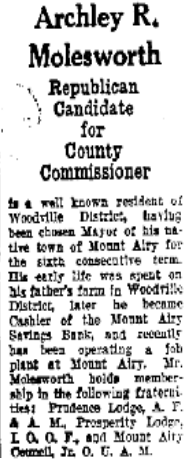
From the October 30, 1930 edition of the Frederick Daily Post.

 During his final term as mayor, Molesworth was named to the Board of Commissioners of Frederick County and served a four-year term that concluded in 1930. This same newspaper also notes that Molesworth lost his reelection bid for a seat on the board by "a margin of thirty votes"!
  Although defeated for reelection, Molesworth continued to serve the Frederick County Board of Commissioners in a slightly different capacity, that of chief clerk. Elected to this post in 1934, Molesworth served as clerk until 1938, when he retired to private life. His Frederick Daily Post obituary remarks that he was regarded as an "acknowledged authority on matters of the county" during his later years, and is mentioned as operating a printing press at his home as a "sideline hobby". This same newspaper notes that he maintained active involvement in a number of local fraternal organizations, including the Prosperity Lodge #58 of the International Order of Odd-Fellows and the Prudence Lodge #190 of Free and Accepted Masons. Molesworth was also a longtime parishioner at the Prospect Church in Mt. Airy.
  Archley Molesworth is recorded as suffering from a heart ailment during his later years, and this condition eventually led to his death on December 29, 1944, at age 70. His wife Ardella survived him by several years, dying in 1953 at age 73. Both were interred at the Prospect Cemetery in Mt. Airy, Maryland.

Molesworth's obituary as it appeared in the December 30, 1944 Frederick Daily Post.

Tuesday, February 21, 2012

Trevanion William Hugo (1848-1923), Trevanyon Levonia Mathews (1849-1944)


   A standout figure in the city of Duluth, Minnesota, Trevanion William Hugo was a two-term mayor of that city who was also a distinguished figure in American Masonry. I first discovered T.W. Hugo on a historical roster of past Duluth mayors and during research on his life, I was pleasantly surprised to discover that several articles and pictures of him existed in some form or another. I wish this could be the story behind some of the other profiles on the site here, and considering the overall obscurity of Mr. Hugo, the wealth of articles mentioning him is a lasting testament to his reputation and public stature.
  Hugo was originally born in Boddinoc, Cornwall, England on July 29, 1848, the son of Nicholas Trevanion Kemp Hugo (1823-1906) and his wife Mary Rendle Marks. While Trevanion was still a child the Hugo family resettled in Kingston, Ontario, Canada, where he attended the common schools. After leaving school, Hugo worked as a machinist for several years and later served as a marine engineer aboard numerous steamships on the Great Lakes. In September 1872 he married in Kingston to Ms. Jean Lanigan (1851-1902), with whom he had two sons, Victor Rendle Marks (1873-1913) and Rene Trevanion (1881-1924).
  Hugo resettled in Duluth, Minnesota with his family in 1881 and during the mid-1880s was employed as the chief engineer of the Consolidated Elevator Company. Hugo also used his engineering expertise in connection with the Hartford Steam Boiler Inspection and Insurance Company, where he was a consulting engineer. Hugo is noted as being one of the first members of the American Society of Mechanical Engineers, and the second member ever from Canada.
  Sources of the time stress Trevanion Hugo's activity with the Masonic Fraternity, both in Canada and Minnesota. During his life, he was accorded numerous honors from this organization, including a stint as Grand Chancellor of the Supreme Council Scottish Rite of Free Masonry and later as the Sovereign Grand Inspector General of Minnesota. He was also active in publishing Masonic literature and authored an index on the Morals and Dogma of Masonry
  In addition to his prolific Masonic activities, Trevanion Hugo was also a widely known public official in Duluth, serving as a member of the Duluth Public Library Board and was the President of the Duluth School Board. While these activities garnered Hugo a high public profile, he didn't actively pursue political office until 1890, when he won a seat on the Duluth City Council. He later was named the President of this Council and in 1900 was elected as the Mayor of Duluth, serving a term of four years. A newspaper photo mentioning Hugo's tenure as mayor (as well as his service as a Republican National Convention delegate) is posted below.

              This picture of  Hugo appeared in the March 17, 1904 edition of the Minneapolis Journal.

    After his mayoral term, Hugo helped compile and edit the first volume of the History of Duluth and St. Louis County, which was published in 1910. The portrait of Hugo at the beginning of this profile was featured in that book. He returned to the political stage in 1920 when he was named as the acting Mayor of Duluth, upon the resignation of Clarence R. Magney (1883-1962). Hugo served out the rest of Magney's unexpired term into early 1921 when a successor, Samuel Snively, was elected.
  Trevanion William Hugo continued prominence in the Masonic fraternity late into his life and died at age 75 on February 27, 1923, as a result of "a relapse from a slight attack of influenza". The Duluth News Tribune memorialized Hugo as a "cultured gentleman in the best American meaning of the word" and that "few men better deserved the title of useful citizen."

                     This portrait of Trevanion Hugo appeared in the 1902 edition of "Men of Minnesota".

  In an interesting update to this article..... on March 4, 2012, a previously unknown politician was discovered who also has the given name "Trevanion", albeit with a slight variation in spelling. Read on to find out more!

From 1854-1904 Nebraskans.

  Shown above is Trevanyon Levonia Mathews, a resident of Cass County, Illinois who served one term in his state's House of Representatives in the early 1880s. Mathews (some sources spell his name with two "t's") later relocated to Nebraska, where he was an unsuccessful aspirant for state auditor and later was named U.S. Marshal, serving in the latter post for eight years.
  Trevanyon Mathews was originally born in the town of Florence, Pennsylvania on March 1, 1849. He migrated to Cass County, Illinois in the mid-1860s and eventually moved to the town of Virginia in 1876. It was here that he became apprenticed to a carriage manufacturing outfit and engaged in this vocation for several years. Also during this time, he began learning the printing trade and in the late 1870s became the editor of the Virginia Gazette newspaper.
  During his career as a publisher and printer, Mathews became active in local political circles and eventually mounted an unsuccessful campaign for county circuit clerk.  He would serve as deputy sheriff and collector of taxes for the county in 1878 and in 1882 was elected by the citizens of Cass County as a Republican to the Illinois State House of Representatives. During his two-year term, Mathews held a seat on the House Committees of Revenue, Canal and River Development, and Fish and Game. A roster from the 1883 legislative session (in which Matthews served) is posted below.


  Trevanyon L. Mathews resettled in Nebraska in the early 1890s and in 1892 organized the Nebraska State Building and Loan Association in Fremont, to which he was connected for many years. He also continued political involvement following his resettlement, and in 1894 and 1896 he was a speaker at the state Republican State Central Committee. In 1898 Mathews was the Republican candidate for state auditor but was defeated by a slim majority. Mathews would also be engaged as a campaign manager for Monroe Leland Hayward in his successful campaign for U.S. Senator from Nebraska in 1899. Despite his win, Hayward died before taking the oath of office in December of that year.
 In 1899 Mathews was tapped by President McKinley to serve as U.S. Marshal for Nebraska and was reappointed to another four-year term in 1903 by President Roosevelt. In 1908 he was named as cashier for the Fremont Trust and Savings Bank, and five years later founded the Fremont Savings Bank, of which he served as cashier and president. Active in several civic and church endeavors in his adopted home state, Mathews served three years as president of the state Sunday School Association, was a member of the Masonic Order, Knights Templar, and the Order of the Eastern Star, and held the directorship of the Fremont Hotel Company.
  After decades of public service in both Illinois and Nebraska, Trevanyon Levonia Mathews died in Fremont on June 2, 1944, at age 95, having been ill for a week before his death. He was survived by his son Reece and was interred at the Ridge Cemetery in Fremont.

From the Fremont Tribune, June 2, 1944.