Portrait from Jet magazine, November 22, 1973.
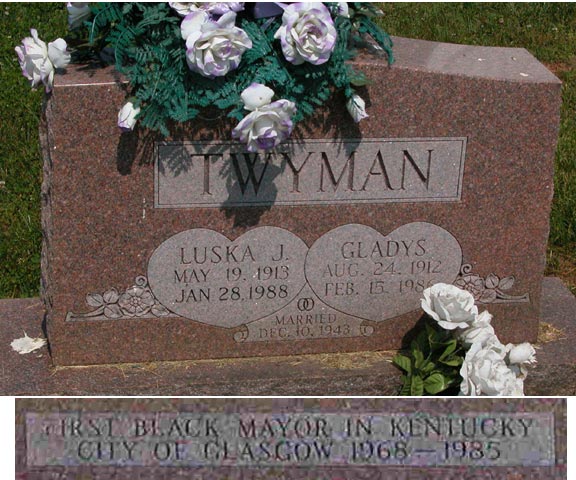
With February being Black History month, the Strangest Names In American History begins a month-long look at several unusually named African-American political figures, the first of whom is Luska Joseph Twyman, a World War II veteran, and educator who etched his name into the history books in 1968 when he became the first African-American to serve as mayor of a Kentucky city. Being appointed as mayor of the city of Glasgow, Twyman would win a term of his own the following year and was continually re-elected to that office until retiring in 1986. The son of Edward and Elza Twyman, Luska Joseph Twyman was born in Hiseville, Kentucky on May 19, 1913.
A student in schools local to Barren County, Kentucky, Twyman graduated from the Mayo-Underwood High School in Frankfort. He would go on to attend the University of Kentucky (graduating in 1939 with his bachelor's degree) and started his career in education at the all-black Oak Grove school. Luska Twyman married on December 10, 1943, to Gladys W. Woodson (1912-1986), to whom he was wed for over forty years. The couple would remain childless.
Twyman would put his teaching career on hold during the Second World War, serving in the Philippines. His time in that country saw him as a special agent "throughout the military base from Leyte Gulf to Manila" until 1946. At the conclusion of his service, he returned to Kentucky, and in 1947 took the reigns as school principal of the Glasgow Training School, an all-black school in Barren County. This school would undergo a name change in 1950, being renamed in honor of civil rights leader and future United Nations ambassador Ralph Johnson Bunche.
Luska J.Twyman would continue as principal of the Ralph J. Bunche School following its name change and his stewardship of that school over the next two decades saw it become the first state-accredited, twelve-year school for African-Americans in Barren County. Twyman's efforts toward integration of Kentucky schools saw the Bunche school's 10th, 11th, and 12th grades merged with the Glasgow High School in 1963 and shortly thereafter the Bunche school "was converted to a sixth grade center." Twyman assumed the post of assistant principal of the Glasgow High School in 1964 (serving until 1975) and would also serve as principal of the Bunche Center well into the twilight of his life.
After a number of years of prominence in Glasgow, Luska Twyman made his first foray into city political life with his election to the Glasgow City Council, his victory marking the first time an African-American had been elected to political office in Barren County. Twyman would serve on the council until 1968 when in that year Mayor Robert Lessenberry resigned. Twyman was subsequently elected to fill the vacant mayoral chair by his fellow councilmembers and took office as the first black mayor in Kentucky history. Despite his history-making achievement, Twyman remained nonplussed, remarking that "if the (mayorship) came my way, I would accept it. But not solicit it." The new mayor would also make light of the meager pay of the office, and his "multiple duties" in addition to his service as principal of the Bunche Center.

Twyman during his mayoralty.
After winning a term of his own as mayor in 1969, Twyman was continually reelected to that office by wide margins, retiring from office in 1986 at age 73. His near twenty-year tenure as mayor saw a number of city improvements, including the expansion of low-income housing, and was "instrumental in the employment advances of Negro personnel in the area, taking personal interest in seeking employment upgrading." In addition to his time as mayor Twyman also was named to several civic organizations, including the Kentucky Education Association, the Municipal Housing Commission, the Barren County Chamber of Commerce, Rotary International, and the Area Development Council. Further honors were accorded to Twyman at the national level with his appointment to the Advisory Council of the U.S. Department of Agriculture and beginning in 1978 was a member of the Kentucky Advisory Committee to the United States Commission on Civil Rights.
Twyman continued prominence in state educational affairs during his term, serving as chairman of the University of Kentucky's Board of Regents in 1980 and was a trustee for that institution, as well as the Simmon's Bible College in Louisville. Two years following his retirement as mayor Luska Joseph Twyman died in Glasgow on January 26, 1988, aged 74. He had been predeceased by his wife Gladys in 1986 and both were interred at the Bearwallow Baptist Cemetery in Hart County. Kentucky.