Showing posts with label New Hampshire House of Representatives. Show all posts

Tuesday, January 10, 2023

Leeman Brackett Wormhood (1881-1960)

 
From Madbury Its People and Places, 1968.

  In its long history, the town of Madbury, New Hampshire was represented in the legislature by two curiously named men, Eloi Augustus Adams (profiled here on November 29, 2019) and Leeman Brackett Wormhood, who is highlighted today. A longtime resident of Madbury, Wormhood was employed by the Boston and Maine Railroad and also farmed in the aforementioned town. A multi-term selectman for Madbury, Wormhood served four years in the New Hampshire House of Representatives beginning in 1945, and later was a delegate to the state constitutional convention of 1956.
  Born in Ossipee, New Hampshire on May 24, 1881, Leeman Brackett Wormhood was the son of Hartley Lord and Julia Eldredge Wormhood. He married Blanche Tibbetts in East Rochester, New Hampshire in 1902. The couple were wed for over fifty years and had a least one son, Leeman Brackett Jr. An engineer on the Boston and Maine Railroad for forty-five years, Wormhood was active in the civic life of Madbury, being a member of the Grange, the Unity Lodge of Free and Accepted Masons, and the Union Congregational Church. 
  On the political front, Wormhood served Madbury in several capacities, including a sixteen-year tenure as town selectman (1930-1946). From 1945-49 he represented Madbury in the state legislature, and from 1949-58 was the town supervisor of the checklist. In 1956 Wormhood retired from farming at his home in Madbury and later resided in a rest home in New Hampshire. In that same year, he served as part of the Strafford County delegation to the state constitutional convention, representing Madbury. Widowed in 1958, Wormhood died in Rochester on December 18, 1960, aged 79, and was interred at the Rochester Cemetery

From the Boston Globe, December 23, 1960.

Saturday, August 27, 2022

Nazaire Elie Biron (1873-1952)

Portrait from the Souvenir of the New Hampshire Legislature, 1901.

  Today marks a return to New Hampshire with a profile on Nazaire Elie Biron, a resident of Manchester who served one term in his state's house of representatives. Born of French Canadian descent in Manchester on September 5, 1873, Nazaire E. Biron was the son of Theophile Georges (1852-1941) and Therese Frechette Biron (1854-1919)
  A student at the Lowell Street and St. Augustine Parochial Schools of Manchester, Biron later studied at the Commercial College of Labaie du Febrve in Quebec, Canada before returning to Manchester, where he studied at St. Mary's Parochial School. Further education was obtained in Quebec at St. Hyacinth College and Laval University. 
  In the late 1890s, Biron followed in his father and brother's stead and joined the family bakery business, operating under the name T.G. Biron and Sons. He was thus employed until September 1900 when he began the study of dentistry in Manchester under Dr. A.J. Sawyer. In 1900 Biron was elected to the New Hampshire House of Representatives from Manchester's 9th ward and sat on the Insurance committee during his term (1901-03).
  Following his service, Biron married Eugenie Perrault (1872-1965) in 1904 and had at least one son, Paul Emile George (1907-1991). Active in French fraternal circles in his city, Biron would serve a term as president of the Cercle Nationale and was the first secretary of the Court  St. Joseph, A.C.A. 
  Nazaire Biron returned to city politics with his service on the Manchester board of aldermen from 1913-15, and from 1925-1927 served on a three-member police commission for the city. Later, in 1936-37, Biron is recorded as the secretary of the New Hampshire Republican Party. Biron died in Manchester on June 7, 1952, aged 78, and was survived by his wife Eugenie, who, following her death at age 92 in 1965 was interred alongside him at the Mount Calvary Cemetery in Manchester. Far from a forgotten figure in that city, Biron is the namesake of the Nazaire E. Biron bridge in Manchester, completed in 1973. 

Friday, November 29, 2019

Eloi Augustus Adams (1894-1969)

From "Madbury: Its People and Places", 1968.

  Two-term New Hampshire state representative Eloi Augustus Adams is unique as he shares an unusual first name with a fictional race of subhumans (the Eloi) featured in H.G. Wells' novel "The Time Machine", published in 1895. In addition to being a longtime farmer in Madbury, New Hampshire, Adams served as Strafford County agricultural agent for three decades and was a leading historian of his area, publishing a history of the town of Madbury in the year prior to his death. Born in Marlboro, Massachusetts on March 27, 1894, Eloi Augustus "Dan" Adams was the son of Joseph and Effie (Williams) Adams.
  A graduate of the Weston High School in Massachusetts,  Adams later studied at the New Hampshire College in Durham and in 1918 received his bachelor of science degree in agriculture. Prior to graduating Adams married in July 1917 to Lena B. Jones (1889-1980) to who he was wed for over fifty years. The couple would be childless. Following his marriage, he and his wife removed to Madbury, New Hampshire, where, after purchasing an 18th farm, they resided for the remainder of their lives.  
  In the years after his resettlement in Madbury Eloi Adams became a leader in Strafford County agricultural circles, and from 1928-1959 served as Strafford County agricultural agent. A past president of the New Hampshire Board of County Agricultural Agents, Adams attained further distinction through his work in developing the Strafford County Soil Conservation District, of which he would serve as secretary. He would serve a term as president of the Northeast Chapter of the Soil Conservation Movement in 1954 and attained prominent rank in several other agricultural and forestry-related posts, including:
  • Director of the New Hampshire Poultry Growers Association.
  • Director of the New Hampshire-Vermont Breeding Association.
  • Strafford County vice president for the Society of the Preservation of New Hampshire Forests.
  • Was the president of the New Hampshire Fair Association.
  • Was an agricultural advisor to the Selective Service System during WWII.
  • Was a past master of the Scammell Grange and the Eastern New Hampshire Pomona Grange.
   Active in the political life of Madbury, Adams held a seat on the board of selectmen from 1921-1948 and was a member of the local school board for nearly a decade. In 1960 Adams was elected, unopposed, to the New Hampshire House of Representatives, polling 182 votes on election day. During the 1961-63 session, he chaired the committee on agriculture and in 1962 was appointed as Strafford County's representative on the State Agricultural Advisory Board, where he served until 1966. In November 1962 Adams would win a second term in the legislature and from 1963-65 again chaired the committee on agriculture.
   Following his service in state government, Eloi A. Adams continued to serve Madbury through civic service, serving as chairman of the town zoning board of adjustment until his death in early 1969. A year prior to his death Adams' history of Madbury (entitled Madbury: Its People and Places) saw publication and was sponsored by Madbury's bicentennial committee, organized to celebrate the town's 200th anniversary in 1968. On March 28, 1969, one day following his 75th birthday, Eloi Adams died at a Dover, New Hampshire hospital. He was survived by his wife Lena, who following her death in 1980, was interred alongside him at the Pine Hill Cemetery in Dover.

Saturday, November 17, 2018

Eralsey Clark Ferguson (1892-1967)

From the 1955 New Hampshire State Register and Manual.

   There were few men more prominent in New Hampshire politics in the 1950s than Eralsey Clark Ferguson, a Merrimack County resident who served eight years in the New Hampshire House of Representatives and two terms in the state senate, holding the position of Senate president in the 1957-58 session. Ferguson would go on to be a Republican candidate for Governor in 1958 and later served three years as chairman of the New Hampshire Milk Control Board. Truly a man of political distinction! A native of Michigan, Eralsey Clark Ferguson was born in Detroit on October 5, 1892, the son of John Gilbert and Mary (Clark) Ferguson.
  Relocating to New England with his family at a young age, Eralsey Ferguson would be a student in the Brookline, Massachusetts school system, and in the early 1910s enrolled at Amherst College in Massachusetts. Graduating in the class of 1916,  Ferguson was granted the opportunity to go overseas as an English and history teacher shortly after leaving Amherst, and for a period taught at the American Mission School in Madera, India. Following his return stateside, Ferguson removed to New York City to take work at the National City Bank, and after a brief period in their employ returned to Massachusetts, where he worked for a short time in the Bethlehem Shipbuilding yard in Squantum. Ferguson married in Newton, Massachusetts in October 1918 to Gertrude Zeiss (1894-1956), to whom he was wed for over thirty years. The couple would have two daughters, Elizabeth Clark (1919-1993) and Nancy. 
   Following a stint as a leather salesman in Boston, Eralsey Ferguson decided to go into business for himself, and in 1920 established a shoe shop in the city of Lynn. By 1924 he had relocated his shop to New Hampshire, and after "combining forces" with an existing shoe factory in Pittsfield sold his business prior to the stock market crash of 1929. After leaving that business, Ferguson took work as a bond salesman with the Chase Security Corp., and later the H.M Sawyer and Sons rainwear manufacturing company of Cambridge. He would purchase an interest in the last-named business and after selling out in 1941 returned with his family to Pittsfield, New Hampshire, where he had kept a home for a number of years prior. 
   After his return to Pittsfield Ferguson worked at farming and first entered the political life of that town in the early 1930s, winning election as a town selectman. He would serve in that capacity from 1933-35 and later was elected as Pittsfield's delegate to the New Hampshire Constitutional Convention that was to be held in May 1948. The 1948 election year proved to be an important year for Ferguson, and in that same year announced his candidacy for a seat in the New Hampshire House of Representatives. In November 1948 Ferguson and fellow Pittsfield Republican E. Harold Young defeated their Democratic opponents and in January 1949 took their seats.
  In addition to various committee assignments during his freshman year in the house, Ferguson was profiled in a substantial write up in the June 16, 1949 edition of the Nashua Telegraph, where he was interviewed about the inner workings of the legislature from the vantage point of a freshman representative. Amongst comments regarding committee work and certain representatives being "specialists in their field", Ferguson would relate that
"I entered this legislature as a freshman with some pre-conceived notions as to what I would find. I have been more than pleased as to what I have learned. The house is not run by a small clique. It is a body of rugged individuals with minds of their own who decide questions for the most part on their merits."
From the Nashua Telegraph, June 26, 1949.

   Ferguson would win a second term in the statehouse in November 1950 and during the 1951-53 session earned the nickname "Frugal Fergie" due to his opposition to a house resolution that aimed to "give legislators, governor, and council a daily newspaper of their choice at state expense of $2,900". Ferguson's efforts against the resolution eventually paid off, and the resolution wasn't passed. Following his successful campaign for a third house term in 1952, Ferguson announced his candidacy for the New Hampshire state senate in mid-1954, and in the September Republican primary won the election, defeating Andrew Nicoll by a vote of 1,717 to 1,096. On general election day in November, Ferguson won out at the polls, besting Democrat Edgar Bellerose by over 800 votes
  Taking his Senate seat in January 1955, Ferguson later won a second Senate term in 1956 and in that same year was elected by his fellow senators as Senate president, serving in that role until 1958. This term would also see Ferguson announce his candidacy for Governor of New Hampshire in May 1957, running on a "pro sales tax platform." In early 1958 he further detailed his platform, proposing:
  • A two percent sales tax with liberal exemptions, to raise an estimated minimum of $10,000,000 
  • Repeal of a $5 head tax
  • Repeal of the tax on livestock
  • Repeal of the stock in trade tax

From the Farmington News, May 2, 1957.

  Ferguson's gubernatorial aspirations were dashed in September 1958 when he lost out in the Republican primary, polling just 1,162 votes against winning candidate Wesley Powell's total of 39,761. Powell, in turn, would go on to win the governorship that November, and later served two terms, leaving office in 1963. 
  Following his defeat for Governor, Eralsey Ferguson served as chairman of the state Milk Control Board from 1959-1962 and ran for a fourth term in the New Hampshire legislature in 1960, but was defeated. He fared better in the 1962 election year and would hold his seat from 1963-65, afterward removing to Scottsdale, Arizona. Widowed in 1956, Ferguson remarried a year later to Madeline Dane (1901-1975), who would survive him upon his death, which occurred in Scottsdale on November 25, 1967. He was later cremated and returned to Pittsfield for burial at the Floral Park Cemetery.

From the Farmington News, November 30, 1967.

Thursday, November 15, 2018

Rotheus Edson Bartlett (1841-1924), Rotheus Hayward Mitchell (1823-1891)

Portrait courtesy of Ancestry.com

  The vast annals of the New Hampshire legislature yield another unusual name in Rotheus Edson Bartlett, a Sullivan County resident who served over twenty years as a Newport town selectman and was also elected to the state house of representatives for one term at the turn of the 20th century. The son of Parker and Eleanor Bartlett, Rotheus Edson Bartlett was born in New Boston, New Hampshire on May 10, 1841.
   A student at the New Boston and Francestown Academy, Bartlett signed on for service in the Civil War in August 1862, enlisting in Co. C, 11th New Hampshire Infantry. This regiment would see action at the battles of Fredericksburg, Vicksburg, the siege of Tennessee, and the eventual capture of Petersburg, Virginia. Bartlett, however, would, "owing to exceptional reliability", be consigned to "headquarters work a good deal of the time". Bartlett was honorably discharged in June 1865 and two years later married to Emma J. Merrill (1840-1927), to who he was wed for nearly sixty years. The couple would have at least three children, including two daughters who died in infancy and a son, the Rev. Ernest Merrill Bartlett (1870-1905)
  Following their marriage, Bartlett and his family resided on a farm in North Newport, New Hampshire, and in the early 1890s made his first move into local politics, winning election to the town board of selectmen. He would serve ten years here, and in 1902 was returned to the board, serving consecutive terms until 1908, and from 1914-1920 again was a selectman. Elected to the New Hampshire House of Representatives as one of several Sullivan County legislators in 1898, Bartlett served in the 1899-1901 session and during his term sat on a special committee for "new apportionment for the assessment of public taxes."
  In addition to his service in local political office Bartlett was a trustee of the Sugar River Savings Bank and in 1898 became a deacon in the Newport Congregational Church. In the late 1900s, Bartlett would hold the post of road agent and Newport town school board member, serving for an indeterminate length of time. Rotheus Bartlett died in Newport of heart failure on June 4, 1924, aged 83 and was survived by his wife Emma, who, following her death in 1927 was interred alongside her husband and son Ernest at the North Newport Cemetery

From the New Hampshire Argus and Spectator, June 13, 1924.


Portrait courtesy of Find-a-Grave.

  The holder of several local political offices in Story County, Iowa, Rotheus Hayward Mitchell was a transplant to that state from Grafton County, New Hampshire. Elected to multiple terms as county surveyor, Mitchell earns placement here on the site due to his election as Judge of Story County in 1865. The son of Horatio and Mary (Ames) Mitchell, Rotheus Hayward Mitchell was born in Lyme, New Hampshire on January 23, 1823.
  Descended from a family who could trace their lineage back to the Pilgrims, Mitchell removed with his family from New Hampshire to New York in 1836 and would attend the St. Lawrence Academy in Potsdam, New York. He learned the trade of millwright during his youth and also began a teaching career that he would follow during the winter months. He married in New York in 1854 to Berintha R. Mott (1827-1864), and the couple's union remained childless.
  In 1856 Mitchell and his wife removed to Story County, Iowa, and within a short period had been appointed as its deputy county surveyor. He would win election as county surveyor the following year, and it would be the first of many times Mitchell would occupy that post. All told he held that office for four terms through 1865, and again from 1874 until his death in 1891. In 1865 he was elected as Judge of Story County and served until 1870.
  Tragedy struck Mitchell in 1864 with the death of his wife Berintha, and in 1866 remarried to Hannah Bixby (1848-1924), who would survive him. The couple had two children, Mary Berintha (1867-1875) and Clara Maria (died in infancy in 1870). He would win reelection as county surveyor in 1874, and in addition to being active in the affairs of the state agricultural college, had a "special fondness for collecting historical books." Mitchell died in Nevada, Iowa on May 15, 1891, at age 68, and was interred at the Nevada Municipal Cemetery.

Tuesday, November 13, 2018

Derostus Pierce Emory (1833-1921), Dorastus Peck (1803-1868)

Portrait from the 1897 Souvenir of New Hampshire Legislators.

   The 1897-98 session of the New Hampshire House of Representatives was populated by several oddly named legislators, and following on the heels of yesterday's write-up on Desire Laneville another member of that particular session is profiled, Derostus Pierce Emory, a resident of Jaffrey who served two legislative terms spaced 20 years apart. A lifelong Granite State resident, Derostus Pierce Emory was born in Rindge, New Hampshire on March 27, 1833, one of several children born to Derostus Wood (1807-1893)  and Mary (Pierce) Emory (1805-1888). Inheriting his unusual first name from his father, Derostus Emery attended school in Rindge and married in November 1858 to Harriett Augusta Davis (1829-1899), to whom he was wed for four decades. The couple would have one son, George P. (1862-1950). 
   Following his marriage, Emory resided in Sharon, New Hampshire, where for three terms he served as a town selectman. In 1875 he was elected as Sharon's representative to the New Hampshire legislature, and during the 1876 session sat on the committee on the Agricultural College. One should note that Emory had some oddly named company during this session, his fellow representatives being Liba Conant Morrison (of Northfield) and Supply Wheeler Edwards (of Temple), both profiled on this site in year's past. 
   Sometime after his legislative service, Derostus Emory removed to Jaffrey, Cheshire County, New Hampshire, where he was engaged in the manufacture of boxes. In November 1896 he won a second term in the house of representatives, narrowly defeating Republican Will J. Mower by a vote of 166 to 161. The 1897-98 term saw Emory sit on the committee on Banks and at the conclusion of his term returned to Jaffrey, where he was affiliated with the Monadnock Savings Bank. A trustee of that bank beginning in the 1890s, Emory would later assume the presidency of that bank in 1906-11. In addition to that bank, Emory served as the director of the Monadnock National Bank beginning in 1891 and held its presidency from 1911 until a year prior to his death. 
   As a prominent man of means in Jaffrey, Emory donated $2,000 of his own money to establish what would become the "Emory fund", used to benefit the town. Following his death in 1921, Emory's son George would donate a further $3,000 dollars to continue the fund and in the centennial year of Dorastus Emory's birth construction was finished on a new fire station in Jaffrey that would be named in his honor in September 1932. Dorastus Pierce Emory died in Jaffrey on February 4, 1921, one month prior to his 88th birthday. Widowed in 1899, both Emory and his wife were interred at the Conant Cemetery in Jaffrey.

Portrait courtesy of the Missouri Historical Society (1865 Constitutional Convention album).

   A distinguished 19th-century figure in Ironton, Missouri, Dorastus Peck was a longtime physician who, following his removal to that city in the late 1850s, had fleeting involvement in politics, being a delegate to the 1865 Missouri State Constitutional Convention. The youngest of thirteen children born to Peleg and Betsy (Sweet) Peck, Dorastus Peck was born on August 23, 1803, in Otsego County, New York. 
  Deciding upon a career in medicine early in life, Peck began his studies in Herkimer County and in 1825 married his first wife Rosilla (Park) Peck (1809-1846). This marriage would see the births of seven children, Freelove Eliza (born 1827), Lucy (born 1830), Carroll Romeyn (1831-1896), Eliva Geraldine (1834-1916), Caroline Lucinda (born 1837), Warren Elijah (1841-1868), and Franklin Thomas (1843-1916). Following Rosilla Peck's death in 1846 he remarried to Ellen F. Cooper, with whom he had a further four children, (Charles, Leonard, Manly, and George) between 1850 and 1862.
  After being admitted to practice, Peck established himself in Licking County, Ohio, where he remained until 1841. This was followed by residence in Keosauqua, Iowa, where he practiced medicine until 1859 when he relocated to Ironton. He continued his practice in that city and in 1864 was elected as a delegate to the Missouri Constitutional Convention, which convened in St. Louis in January 1865. This convention's work would include abolishing slavery in the state by a 60 to 4 vote on January 11, and one month later officially adopted the 13th amendment. 
  Peck continued to reside in Ironton following his convention service, his last year being marred by a "disease of the lungs." He died aged 64 on June 18, 1868, in Ironton and was later buried at the Masonic Cemetery in that city.

Sunday, November 11, 2018

Desire Laneville (1860-1935)

From the Souvenir of New Hampshire Legislators, 1897. 

   Certainly one of the few American political figures bestowed the first name "Desire", Desire Laneville wasn't a native of the United States; his birth instead occurring in Quebec, Canada. A three-term member of the New Hampshire  House of Representatives from Manchester, Laneville had previously served a term on the Manchester city council. Born in Arthabaska, Province of Quebec, Canada on August 10, 1860, Desire Laneville was the son of Paul and Adelaide (Bourbeau) Laneville
   Removing to Manchester, New Hampshire with his family at age 6, Laneville would attend "the parochial schools" of that city and during his youth was employed in both a bobbin shop and grocery store. He married in that city in April 1879 to Cordelia Lucier, with whom he had at least five children, including Albert, Alice, LeolaEvelyne, and Pauline. Laneville continued grocery store work at the Morency store in Manchester and left that employ in 1890 to take work at a paint shop, located in the same city. 
   Partnering with F.H. Lussier, Laneville would be affiliated with that business for nearly a year, and after selling off his interest returned to grocery store work, and after partnering with J.F. Lacourse for a two year period left to join the Daniels-Cornell Co., a Manchester-based wholesale grocery house and flour dealer. In addition to the above places of employment, Laneville was also a founding organizer and captain in the Manchester Garde Lafayette in 1887, a French-Canadian military Garde "considered to be the first organized infantry of the national guard in the state of New Hampshire."
  Desire Laneville made his first entrance into Manchester politics in 1888, when he was elected to that city's common council. He served here for one term and in 1892 was elected to his first term in the New Hampshire House of Representatives, from Manchester's 4th ward. The 1893-94 session saw Laneville named to the committee on County Affairs and would win a second term in November 1896, subsequently serving on the committee on claims from 1897-98. In November 1900 he won his third and last house term and was again a member of the County Affairs committee during the 1901-02 session.     
   Despite living to age 75, Desire Laneville's life following his legislative service largely remains a mystery. He was later a resident of Goffstown in Hillsborough County and died in that city on February 15, 1935. A burial location for he and his wife Cordelia remains unknown at this time.

From the 1897 Souvenir of New Hampshire Legislators.

Saturday, November 10, 2018

Jotham Dutton Otterson (1805-1880)

Portrait from the History of the City of Nashua, 1897.

  Long a leading figure in the business and political life of Nashua, New Hampshire, Jotham Dutton Otterson served that city as its mayor from 1869-71 and later served two terms in the state house of representatives from Hillsborough County. The son of James and Martha (Chase) Otterson, Jotham Dutton Otterson was born in Hooksett, New Hampshire on September 11, 1805. Descended from Irish immigrants, young Jotham attended school in Hooksett and later was a student at the Blanchard Academy in the neighboring town of Pembroke.
  Early in his life, Otterson began learning the trades of mechanic and iron molding, being employed in various machinist shops throughout New Hampshire and Massachusetts. By 1833 he had settled in Nashua, and after taking work with the Nashua Manufacturing Company removed to Clinton, Massachusetts, where for several years he held the superintendency of the Lancaster Mills, a large factory complex devoted to the manufacture of cotton and woven gingham fabrics
   In 1850 Otterson removed back to Nashua and soon after purchased the Nashua Lock Company, makers of "Locks, Knobs, Escutcheons, Bell Pulls, Butt Hinges, etc." Along with two partners, L.W. Noyes and Robert Living, Otterson remained affiliated with the business until dissolving their partnership, whereafter he established J.D. Otterson & Co., a foundry that by the early 1870s "employed fifty hands and did a business amounting to $60,000." Otterson's eldest son James Parker Scribner Otterson was later admitted as a partner in the business, which continued operations until the elder Otterson's death in 1880. Period sources relate that Otterson was " one of the truly good and generous men of Nashua" as well as a:
"Conservative and practical businessman who paid good wages and took a deep interest in everything that had a tendency to dignify labor and promote the welfare of the laboring man."
  Jotham D. Otterson first married in 1830 to Sarah Emery Scribner (1811-1852), with whom he had eight children, James Parker Scribner (1831-1913), Mary (1833-1915), Lafayette Washington (died in infancy in 1837), Sarah Emery Dana (1838-1906) Nancy Emery (1841-1923), George Washington (1843-1919), Ann Maria (born 1847) and William Henry (died in infancy in 1851). Following Sarah Otterson's death in January 1852 he remarried that December to Athol, Massachusetts resident Lucia Fish (1814-1891), who survived him upon his death.

Portrait courtesy of Find a Grave.

   After years of distinction in New England business circles, Jotham D. Otterson entered the political life of Nashua in 1869, his name being put forward for mayor of that city at the March Republican city caucus. Following balloting, Otterson received 253 votes out of the 376 cast, duly earning the nomination and was subsequently profiled in the March 8, 1869 issue of the Nashua Daily Telegraph, which acknowledged him as a man who:
"Feels a deep interest in the welfare of Nashua, and is always ready to give his influence and aid to every enterprise calculated to advance his prosperity and growth. He richly deserves the honor that has been conferred upon him, and we cannot doubt that those who nominated him for the position of mayor wil see to it that he receives a triumphant election. He is just the man for the place at this time."
From the Nashua Daily Telegraph, March 8, 1869.

   Otterson would win the mayoralty in early March 1869, defeating Democratic nominee J.L. Pierce by a vote of 1,016 to 727. His first year as mayor saw Nashua be visited by President Ulysses Grant in August 1869, and Otterson himself had the honor of presenting the president to the Nashua citizenry at the Concord train depot. Otterson would be renominated for a second term as mayor in March 1870, his first term being noted as one of "marked fidelity and energy." Otterson would emerge triumphant at the polls on March 9th, polling 914 votes to his opponent's 848, and served until March 1871, the Republican nomination for mayor going to another curiously named man, Gilman Scripture (1813-1887), who in turn was defeated by Democrat Dana Sargent.
   Following his mayoralty, Otterson experienced further political success when he was elected to the New Hampshire House of Representatives from Hillsborough County, and during the 1873-74 session sat on the house committee on the Judiciary and a special committee on the subject of Temperance. Otterson was returned to the house for a second term, and the 1875-76 session saw him continue service on the judiciary committee and also introduced a bill to "the Worcester and Nashua Railroad to purchase and hold bonds or stock of the Nashua and Rochester Railroad Company."
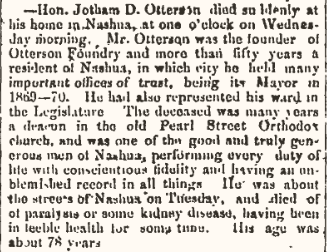
   Jotham Otterson continued prominence in Nashua after leaving the legislature, being a member of the city's International Order of Odd Fellows chapter, as well as a generous contributor to the Pearl Street Congregational Church, where he was a longstanding parishioner. He died in Nashua on June 2, 1880, aged 74 and was interred alongside his first wife Sarah at the Universalist Church Cemetery in that city.

From the Amherst, New Hampshire Farmer's Cabinet, June 8, 1880.

Friday, November 9, 2018

Hanover Osgood Wells (1828-1898), Hanover Dickey (1775-1843)

Portrait courtesy of "The Descendants of Samuel Osgood".  

   Following three profiles on oddly named political figures from Connecticut we journey to the Granite State's northern neighbor New Hampshire to highlight the life of Hanover Osgood Wells, an obscure resident of Epsom who served a term in his state's house of representatives. A son of Capt. Samuel and Eleanor (Dickey) Wells, Hanover Osgood Wells was born in Epsom on May 29, 1828. Little information is available regarding Wells' early life in Epsom or his education, and he married in that town in February 1856 to Mary Sarah Brown (1834-1897). The couple were wed for over four decades and had five children, Edward Eugene (1856-1926), Ida (1858-1909), Etta (1860-1910), Clarence Oscar (1862-1937) and Alice (1874-1903).
   As a farmer in Epsom, Hanover O. Wells was deeded his father-in-law's 114-acre farm in 1870, continuing to operate it until his death nearly three decades later. Following his death in 1898 ownership passed to his sons Edward and Clarence. 
   Active in the religious and political life of Epsom, Hanover O. Wells was a founding member of the First Christian Society of Epsom in 1861 and entered into local politics in 1867 when he was elected to the Epsom board of selectmen. He would serve back to back terms in 1868-1869 and again from 1872-73, and served another term in 1885. In 1886 he was elected as Epsom's representative to the New Hampshire House of Representatives and during the 1887-89 term was a member of the committee on ClaimsLittle else is known of Wells' life after his legislative service. Widowed in 1897, he died one year after his wife Mary on August 25, 1898, in Epsom. Both Wells and his wife were interred at the Rye Cemetery in that town

From the Epsom Town Register, 1909.

  In addition to Hanover Osgood Wells' political service to Epsom, attention must also be given to Hanover Dickey (1773-1845), his maternal grandfather. Even more obscure than his grandson, Dickey served Epsom as a member of the board of selectmen on multiple occasions and was also a two-term state representative. Born in 1773, Hanover Dickey was the son of David and Rachel (Hanover) Dickey. He married in 1799 to Lydia Osgood (1781-1866) and the couple's marriage saw the births of three children, Eleanor (mother of Hanover Osgood Wells), David (1806-1877) and Hanover (1807-1873).
  Hanover Dickey served as first selectman for Epsom from 1819-1825 and was a board of selectmen member in 1817 and 1826. He was elected to the state legislature for the first time in 1818 (serving from 1819-21) and was returned to that body on two further occasions in 1829 and 1842. Dickey died in Epsom on May 13, 1845, aged 72, and was buried at the McClary-Epsom Center Cemetery.

Saturday, October 7, 2017

Parsons Brainard Cogswell (1828-1895)

Portrait from the Proceedings of the New Hampshire Historical Society, Vol. 3.

"Always a plain man of the people, he recognized no cliques or classes as an editor or public man. He greeted the poor and rich alike, and in the days of his prosperity never failed to remember the companions of his hours of toil at the compositor's case or the printing press. This characteristic made warm friends of all who knew him,  but he had others which were only known to his nearer and more intimate associates."
   Such was the memorial given to Parsons Brainard Cogswell, one of New Hampshire's preeminent newspaper publishers and editors during the 19th century. In addition to success in his chosen field, Cogswell also made an impact in Granite State political life, being a two-term state representative, New Hampshire state printer and Mayor of Concord. The fifth born son of David and Hannah (Haskell) Cogswell, Parsons Brainard Cogswell was born in Henniker, New Hampshire on January 22, 1828. 
  Cogswell's formative years were spent on the farm and his education was centered during the winter months at district schools. For an eight-month period Cogswell attended an academy in Clinton Grove, where, under the tutelage of principal Moses Cartland, he first became "strongly attached to anti-slavery tenets and temperance." At the age of just 19 Cogswell was called to enter the printing trade, and in 1847 joined the staff of the Independent Democrat in Concord. During his two years in their offices Cogswell gained wide knowledge of the printer's daily activities and by 1849 had moved on to the New Hampshire Patriot, also located in Concord. His three-year tenure on the Patriot staff also saw him employed for several weeks in Massachusetts, working with the Cape Ann Light and Gloucester Telegraph newspapers.
  In 1852 Cogswell left the New Hampshire Patriot to join the print firm of Tripp and Osgood, where he was engaged in "book and job work." In March 1854 he and Abraham Gates Jones (a future Mayor of Concord) pooled resources and together purchased the aforementioned business, which they operated until 1858, after which Cogswell "assumed whole control of the business." He continued along this route until 1863 when he took on George Sturtevant as a partner, and in May of the following year, they launched the Concord Daily Monitor, notable for being the first daily newspaper to be issued in the city. While being one of the paper's founders, Cogswell had a hand in nearly every aspect of the paper's production, serving
"In every editorial department, as local, associate and managing editor, and as an editorial writer, wielding a vigorous pen, and contributing with strength to every department of the paper." 
   Several years after its founding the Daily Monitor was consolidated with two other papers, those being the Independent Democrat and the New Hampshire Statesman. Cogswell (as a member of the Republican Press Association, the guiding light behind the consolidation) maintained a large presence in the Monitor's continued production, being at various times managing editor and editor in chief.
   Parsons B. Cogswell first entered the political life of Concord in 1858, when he won a seat on the Union school district's school committee. In the following year, he began a lengthy tenure on the Concord city board of education, continuing to serve until he died in 1895. Cogswell also held the presidency of that board for several years and for nearly two decades was its financial agent.

From a bookplate in the collection of the Concord Public Library.

   In 1871 Parsons Cogswell was elected as one of Merrimack County's representatives to the New Hampshire General Court, and in 1872 won a second term. His terms in the legislature saw him sit on the committees on the Asylum For the Insane and Bills in the Second Reading. During these terms, Cogswell also served as president of the New Hampshire Press Association (1872-75) and in 1876 was its recording secretary. 
   1877 saw Cogswell embark on an extended journey through California, Oregon, and several other states, whilst later visiting Canada. He would continue his travels into 1878 and 1879, venturing across the Atlantic Ocean to traverse "Europe, the Holy Land and Egypt". During his travels overseas Cogswell documented his journey through letters published in the Daily Monitor and the Independent Statesman. Due to a growing interest from those paper's subscribers, Cogswell's travelogues were later published in book form following his return stateside in 1880, under the title Glints From Over the Water
   Cogswell returned to Granite State political life in June 1881 when he entered into the post of New Hampshire State Printer, an office he'd continue to hold until 1885. During his term, Cogswell oversaw the publishing of numerous works relating to early New Hampshire history, including documents related to the state constitutional conventions of 1778-79 and 1781-83, rolls of New Hampshire soldiers during the Revolutionary War, and census statistics for the state. 
   Active in several non-political areas in Concord, Cogswell was for many years a trustee of the state library and a past president of both the Concord Commercial Club and the New Hampshire Historical SocietyOn September 22, 1888, Cogswell married to Helen Buffam Pillsbury (1843-1929), the daughter of noted New Hampshire abolitionist and reformer Parker Pillsbury (1809-1898). Despite marrying late in life (as well as a fifteen-year age difference between them) Cogswell and his wife's family had been extremely close for a number of years prior, as he had boarded with the family beginning in 1848. Parker Pillsbury would, in turn, have a large effect on Cogswell, who early in his life embraced many of Pillsbury's ideas in regards to social activism, women's rights and the abolition of slavery. Cogswell would put much of what he learned from his future father-in-law into action during his time as director of the Lyceum in Concord, inviting reform-minded speakers to lecture on a broad range of topics, including prohibition and equal rights.
   In 1892 Cogswell returned to government service when he was appointed by then-President Benjamin Harrison as U.S. Inspector of Immigrants at Concord, holding that post until his resignation in January of the following year. In the same year as his appointment as immigrant inspector, Cogswell was elected as Mayor of Concord and entered into his duties in January 1893. During his term, he spoke at the dedication of the new state library building and was "interested in all measures tending to improve Concord." 
   Parsons Cogswell's term as mayor concluded in January 1895 and on October 28th of that year died of pneumonia at his home in Concord. News of his passing made the pages of the New York Sun within a day of his death, and he was subsequently memorialized as a
"Faithful and painstaking servant of the people, seeking with perseverance the ends he believed to be good, and striving with the utmost success to perform his whole duty in whatever station he found himself."
  Helen Pillsbury Cogswell survived her husband by three decades, dying at age 86 on October 29, 1929, one day after the thirty-fourth anniversary of Cogswell's passing. Following her death, she was interred alongside him in the Cogswell-Pillsbury family plot at the Blossom Hill Cemetery in Concord. 

From the New York Sun, October 29, 1895.

Portrait from the History of the Eleventh New Hampshire Regiment, Volunteer Infantry.

  While the Cogswell family could boast of one oddly named politician in Parsons B. Cogswell, attention must also be given to his older brother Leander Winslow Cogswell, who, while not having as unusual a name, left a lasting mark in Granite State politics. A veteran of the Civil War, Cogswell attained the rank of Lieutenant Colonel in Co. D. of the Eleventh Regiment, New Hampshire Volunteer Infantry.
  In 1865 he was elected to the first of four terms as Henniker's representative to the New Hampshire General Court (serving from 1866, 1867 and 1870, 1871) and from 1871-72 served as state treasurer. Cogswell later served five years as one of New Hampshire's savings bank commissioners from 1876-81 and died in Henniker on January 21, 1906, at age 80.